%20(1).jpg)
%20(1).jpg)
Hair Loss Treatment for Afro-Textured Hair: A 2026 Guide

The right hair loss treatment for afro textured hair starts with finding out what’s causing the change. Thinning around the hairline, a widening parting or loss at the crown can have different causes, and choosing an unsuitable approach may delay the care you need.
If you’re concerned that general hair advice doesn’t account for your texture, scalp or styling practices, that’s understandable. Tension from tight styles can contribute to hair loss, while conditions such as central centrifugal cicatricial alopecia (CCCA) can cause progressive, scarring loss. Because assessment and management differ, an accurate diagnosis matters before you decide on a next step.
This guide explains what clinicians may consider when assessing hair loss in Afro-textured hair and compares non-surgical options such as PRP, GFC and Regenera Activa with DHI, a restorative option considered when transplantation is clinically appropriate. You’ll also find practical points to discuss during an individual assessment, including the pattern and duration of hair loss, scalp symptoms, medical history and styling habits. The aim is to help you make an informed decision, not promise a one-size-fits-all result.
Table of Contents
Hair loss in afro-textured hair: why identifying the cause comes first
The right hair loss treatment for afro textured hair depends on the cause, the pattern and pace of change, and an individual clinical assessment. Afro-textured hair describes tightly curled or coiled hair across a range of curl shapes and densities. It isn’t a diagnosis, and texture alone can’t explain why hair is thinning or which treatment may be suitable.
Hair loss can have several causes. Repeated tension from some tight styles may contribute to traction-related loss, while medical conditions, including inflammatory or scarring disorders, can affect the scalp and follicles. These possibilities call for different responses, so a clinician needs to assess what is happening before selecting a treatment.
This video discusses thinning edges and care for afro and curly hair. It offers general information, not a diagnosis or an individual treatment recommendation.
How hair loss can appear across different curl patterns
You might notice increased shedding, a parting that looks wider, reduced density in one area or a hairline that seems to be receding. The change may be gradual or become more noticeable over time. Hair loss can affect people of any gender, and a particular hairstyle or curl pattern does not, on its own, explain the cause.
Hair texture describes the strand; it does not identify the cause of hair loss. For instance, traction alopecia is associated with prolonged pulling on the hair. The overview of Traction alopecia describes this form of hair loss and its relationship to tension. Other conditions can involve scalp inflammation or scarring, which needs clinical assessment rather than assumptions based on appearance.
Why early assessment can clarify the next step
A clinician can build a clearer picture by discussing your health and hair history, examining your scalp, and reviewing where the loss is occurring and how it has changed. Tell them when you first noticed a difference, whether it is progressing, and whether you have itching, tenderness or other scalp symptoms. Mention styling practices and previous treatments too. These details help provide context without requiring you to self-diagnose.
Assessment can be particularly useful if hair loss is progressing or your scalp feels uncomfortable. Some causes may need attention to the underlying condition, while others may call for a different plan. Understanding hair-loss causes can help you prepare for that conversation, but online information can’t replace an individual examination. Treatment suitability depends on the clinician’s findings and your goals.
How clinicians assess afro-textured hair before recommending treatment
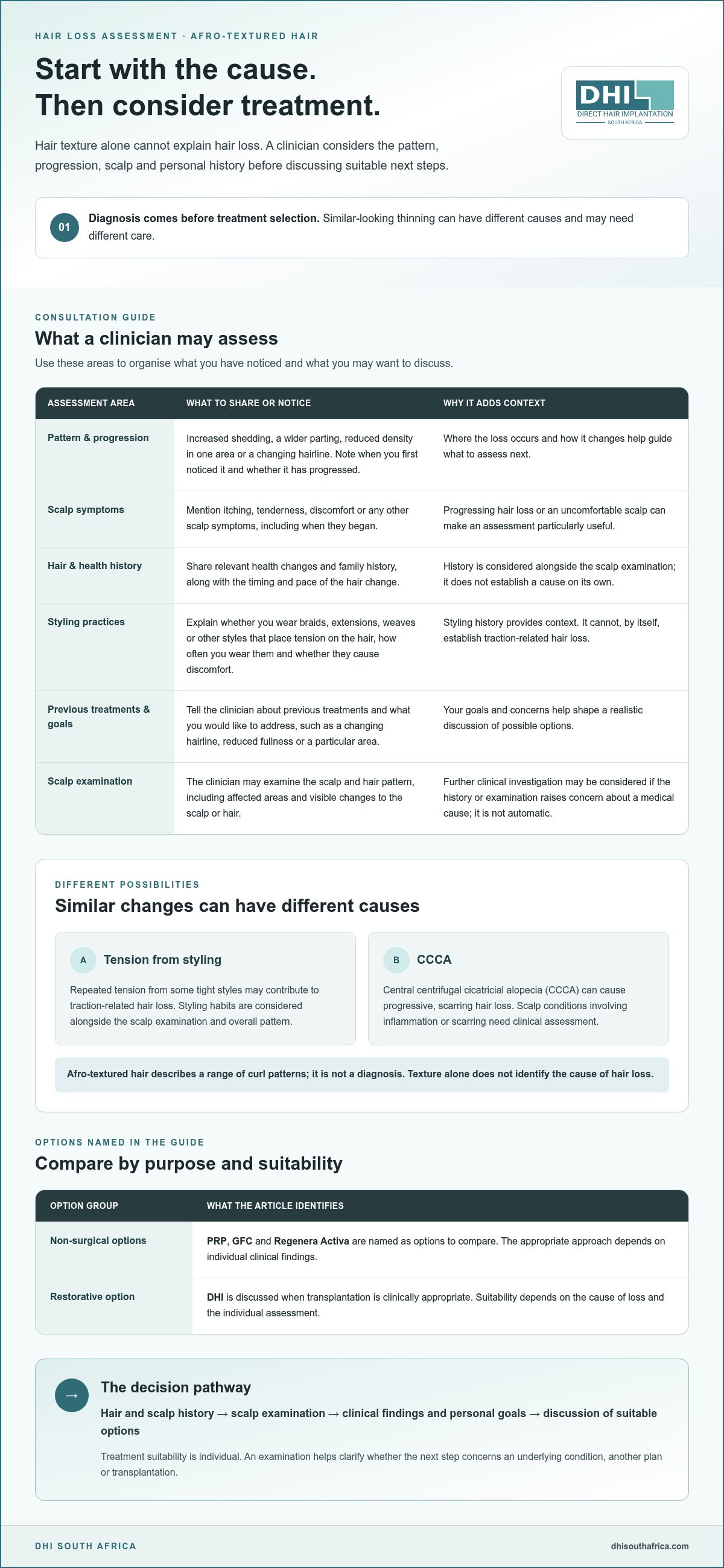
A careful assessment helps turn uncertainty into a considered plan. Rather than choosing a treatment based on appearance or curl pattern alone, a clinician gathers your history, examines your scalp, reviews where and how your hair has changed, and discusses your goals. Each part adds context and helps guide the next step.
Diagnosis should come before treatment selection, because the same visible thinning can have different underlying causes and need different care. This matters when considering hair loss treatment for afro textured hair: suitability depends on your clinical findings, not texture alone.
What a hair-loss consultation may consider
The conversation may begin with when you first noticed a change and whether it has remained stable or progressed. Your clinician may ask about family history, relevant health changes, scalp symptoms, previous treatments and how you usually care for your hair. Share what you’ve noticed, even if it seems small, such as a tender area or a change in shedding.
Styling history is useful context, not a reason for blame. If you wear braids, extensions, weaves or other styles that place tension on the hair, explain how often you wear them and whether they cause discomfort. That information alone cannot establish traction-related loss; it should be considered alongside the scalp examination and overall pattern. The American Academy of Dermatology’s guidance on hair loss in Black women discusses conditions such as traction alopecia and central centrifugal cicatricial alopecia (CCCA), underlining why an accurate clinical picture matters.
The clinician will examine your scalp and hair pattern, looking at the areas affected and any visible changes to the scalp or hair. The assessment doesn’t automatically require a particular test. If the history or examination raises concern about a medical cause, further clinical investigation may be considered as appropriate. What that involves depends on the individual findings.
Texture-aware planning without assumptions
Your curl pattern and scalp findings belong in the discussion, but neither should be used as a shortcut to diagnosis. People with afro-textured hair don’t all have the same hair characteristics, styling routines or causes of loss. A thoughtful assessment considers your specific presentation rather than assuming one texture or hairstyle explains every change.
Tell the clinician what you want to address, whether that’s a changing hairline, reduced fullness or a particular area of concern. You can also discuss what you feel comfortable trying and any concerns about treatment. These goals help shape a realistic conversation, while the examination establishes which options are clinically relevant. No single treatment should be presented as suitable for everyone.
DHI South Africa’s specialist assessment considers your hair-loss concerns and clinical findings before discussing an appropriate next step.
Comparing hair loss treatments for afro-textured hair
Treatment options serve different purposes. Supportive care can help reduce avoidable stress on the hair, medical approaches may address particular causes or support hair management, and transplantation can restore hair to selected areas when clinical findings make it appropriate. The right choice depends on the cause and progression of loss, donor hair and your assessment. No option suits everyone.
For hair loss treatment for afro textured hair, match the approach to your clinical picture rather than choosing by curl pattern or popularity. Clinical hair-loss treatment options and advanced hair-loss approaches have different purposes and limitations, which should be considered as part of an individual plan.
Non-surgical approaches and their role
Supportive care may include reviewing practices that create repeated tension, alongside suitable hair and scalp care. A clinician may consider medical therapies when they fit the diagnosed cause. These approaches aren’t interchangeable, and they shouldn’t be assumed to replace assessment or address every underlying condition.
DHI South Africa offers several non-surgical treatments, each with a distinct approach:
GFC treatment uses growth factors derived from the patient’s own blood.
PRP hair-loss treatment uses platelet-rich plasma prepared from the patient’s blood.
Regenera Activa is an autologous micro-grafting treatment; its role depends on individual clinical assessment.
These descriptions explain how the options differ, not what result any one person should expect. A specialist can discuss whether a treatment is relevant to your findings, what it is intended to address and how progress would be reviewed. None should be assumed to substitute for care directed at an underlying condition.
When hair transplantation may be considered
Direct Hair Implantation (DHI) is a restorative procedure that relocates the patient’s own follicles to areas selected during clinical planning. It may be considered when the assessment supports transplantation, including consideration of the donor area and pattern of loss. It isn’t automatically appropriate for every type or stage of hair loss.
The Direct Hair Implantation procedure uses a patented, single-step implantation system. The DHI Implanter gives the clinician control over the angle, depth and direction of placement, helping guide each hair according to the plan. This technical control doesn’t guarantee a particular density or outcome; planning must reflect your scalp, donor hair and goals.
An individual assessment can help clarify whether DHI, a non-surgical approach, supportive care or monitoring is the more suitable next step. DHI South Africa’s specialists can discuss your concerns and the options relevant to your clinical findings.
How to prepare for a hair-loss consultation and compare your options
A little preparation can make a hair-loss consultation more useful and help you leave with a clearer understanding of what happens next. You don’t need to arrive with a diagnosis. Your observations, concerns and questions give the clinician helpful context for assessing your situation and discussing realistic options.
Before your appointment, note:
Symptoms: where you’ve noticed thinning or shedding, and whether there’s discomfort or a change in your scalp.
Timeline: when the change began and whether it has stayed stable or progressed.
Hair and scalp history: relevant health or family history, previous treatments and your usual styling practices.
Goals and concerns: what you hope to address, what you’re comfortable considering and anything you’re unsure about.
If it helps, bring a short written timeline or photos that show changes over time. Mention braids, extensions, weaves, chemical treatments or other styling habits without feeling you need to explain or defend them. They’re part of the picture, not a diagnosis by themselves.
[Illustrative diagram: consultation sequence from hair and health history to scalp assessment, pattern review and discussion of goals]
Questions to take into your assessment
Useful questions can help you understand the reasoning behind a recommendation. Ask what may be causing your pattern of hair loss and which findings support that view. Then discuss which options fit your individual assessment, what each is intended to address, and what limitations or uncertainties apply.
Ask how progress will be reviewed and documented, and what follow-up may involve. These questions can clarify what to expect without assuming a particular test, treatment or result is right for you.
Setting realistic expectations before treatment
Agreeing on a treatment goal is different from promising an outcome. A clinician can explain what an approach is designed to do and how response may vary between individuals. Ask what signs of progress will be monitored, when the plan will be reviewed and how it may change if your hair loss continues.
Planning for restoration may also take account of future progression and the amount and suitability of available donor hair. That can affect whether transplantation is appropriate and how a plan is shaped; it’s a clinical consideration, not a guaranteed prediction. If you’re reviewing examples, documented hair restoration results can offer context, but individual results aren’t a promise of what you will experience.
When comparing options, consider the clinical rationale, potential risks and limitations, follow-up arrangements and whether the approach addresses your specific findings. The most reassuring plan is one you understand, including what it can and can’t reasonably aim to achieve. This careful comparison is particularly valuable when deciding on hair loss treatment for afro textured hair, since no single option suits every cause, pattern or person.
Use your assessment to understand the options and decide what feels right for you.
DHI South Africa's clinical pathway for afro-textured hair loss
A considered plan starts with your clinical findings, not a procedure. At DHI South Africa, an individual specialist assessment informs whether Direct Hair Implantation (DHI), another clinic treatment or monitoring is the appropriate next step. The recommendation depends on the cause and pattern of loss, its progression, your scalp, available donor hair and what you hope to address.
This matters because a restorative procedure and a non-surgical treatment have different purposes. If the findings don’t support transplantation, the discussion can focus on another relevant option or monitoring rather than moving straight to a procedure. Afro-textured hair alone neither rules a treatment in nor rules it out.
What the DHI approach involves
If assessment supports transplantation, DHI uses the patient’s own follicles, with placement planned according to the individual clinical findings. The DHI Implanter gives the clinician control over angle, depth and direction, allowing placement to follow the plan for the area being treated. Your specialist can explain how the plan accounts for your concerns and available donor hair, and what limitations apply. Suitability is personal, and the technique itself doesn’t guarantee a particular density, appearance or result.
A considered next step with DHI South Africa
DHI, GFC, Regenera Activa and PRP are distinct options, not interchangeable solutions. Assessment helps determine whether one is relevant to your findings, whether another approach or monitoring is more suitable, and how progress will be reviewed. DHI South Africa’s documented protocol includes single-use instruments and structured photographic follow-up. Photographs can help record changes over time, but they don’t guarantee an outcome.
For readers across South Africa, a specialist discussion can connect your hair-loss concerns and goals with an appropriate care pathway. The medical hair restoration pathway in South Africa provides context for how assessment informs restoration planning. You can discuss why an option is being considered and what follow-up may involve before deciding how to proceed.
Take your next step with clarity
Choosing a hair loss treatment for afro textured hair is a personal decision, and you’re entitled to take the time you need. Your next step doesn’t have to be a commitment to treatment. It can simply be a chance to clarify what matters most to you and what you’d like to understand before deciding.
Consider the changes you’ve noticed, the outcome you hope for and any concerns you want addressed. Keeping those priorities in view can help you weigh the information and decide whether you’re ready to proceed, explore alternatives or take more time.
Move forward at your own pace, with a clearer understanding of your options. Explore a personalised hair-loss assessment with DHI South Africa.
Frequently Asked Questions
Can afro-textured hair be treated with DHI?
Yes, DHI may be considered for someone with afro-textured hair if an individual clinical assessment supports transplantation. Curl pattern alone doesn’t determine suitability. A specialist considers the cause and pattern of loss, scalp health and donor hair, then discusses whether implantation is appropriate. You can ask how the hairline and placement plan would be tailored to your features, and what limitations apply in your case.
Is hair loss from tight braids or extensions reversible?
It can be reversible if the follicles haven’t been permanently damaged, but recovery isn’t guaranteed. Repeated pulling from tight braids, extensions or similar styles can cause traction-related hair loss; ongoing tension may lead to lasting damage. If you notice thinning or discomfort, changing styles to reduce tension and seeking clinical advice can help clarify what’s happening. A clinician can assess whether the follicles appear affected and discuss an appropriate next step.
What is central centrifugal cicatricial alopecia?
Central centrifugal cicatricial alopecia, or CCCA, is a form of scarring hair loss that can begin near the crown and spread outwards. Inflammation can damage follicles, and scarring may make the resulting loss permanent. It isn’t caused simply by having afro-textured hair, and it can’t be diagnosed from a photograph alone. If you notice progressive thinning at the crown or scalp discomfort, seek a clinical assessment rather than relying on styling changes alone.
How can I protect afro-textured hair while exploring treatment?
Choose styles that don’t cause persistent pulling or pain, and take note if a particular style seems to worsen breakage or thinning. Handle hair gently during detangling and avoid repeatedly putting tension on an already sensitive area. Keep track of changes and share your styling routine with the clinician; you don’t need to stop or alter everything before an assessment. A clinician can help distinguish breakage from loss at the follicle.
Is PRP suitable for every type of hair loss?
No. PRP isn’t a universal treatment, and its relevance depends on the cause of hair loss, scalp findings and your individual health. For example, an approach intended to support hair in one situation shouldn’t be assumed to treat an active scarring condition or replace care directed at an underlying cause. A clinician can explain whether PRP fits your findings, what it aims to address and how progress would be reviewed.
How do clinicians decide whether hair transplantation is appropriate?
They consider the diagnosis, pattern and progression of hair loss, scalp condition, available donor hair and your goals. If hair loss is changing quickly or an inflammatory scalp condition is suspected, the clinician may need to address or monitor that issue before considering surgery. The assessment should also clarify what transplantation can reasonably target and its limitations, so you can weigh the potential benefits against other options without assuming surgery is the answer.
Can hair loss return after treatment?
Yes, hair loss can continue or recur, depending on its underlying cause and how it changes over time. A treatment may address a particular area or aspect of hair loss without preventing other, untreated causes from affecting surrounding hair. That’s why review matters: tell your clinician about new thinning, shedding or scalp symptoms, and discuss whether your plan needs reassessment. No treatment can guarantee that further hair loss won’t occur.


Comments