%20(1).jpg)
%20(1).jpg)
What to Expect 1 Year After a Hair Transplant: Results and Next Steps

The one-year mark is a useful checkpoint, but it isn’t always the final word on your hair transplant. If you’re wondering what to expect 1 year after hair transplant surgery, you’ll usually have a clearer view of coverage and how the transplanted hair sits. Density can vary, and some areas, particularly the crown, may take longer to develop.
It’s understandable to feel uncertain if your progress doesn’t match a photograph or the result you pictured. Hair texture, growth patterns, the area treated and individual healing all affect how the outcome looks. A less dense appearance doesn’t automatically mean something has gone wrong, but persistent concerns deserve a considered review.
This guide explains what the one-year milestone can show, why results differ and how to assess progress using consistent photographs rather than memory alone. You’ll also find practical points to raise with a specialist if coverage or growth is worrying you. One year is a meaningful point to review your result, not a universal finish line.
Table of Contents
What to expect 1 year after a hair transplant: the visible result
If you’re wondering what to expect 1 year after hair transplant surgery, treat this milestone as a useful progress checkpoint, not a guaranteed finish line. By this stage, you may have a clearer view of coverage and how the transplanted hair sits, but results vary. Your starting point, the area treated and your hair’s growth patterns all influence what you see.
For a visual overview of the recovery journey, watch this video:
How the transplanted area may look around the 12-month mark
You may see more coverage than in the earlier stages, and the transplanted hair may be long enough to style with the rest of your hair. But there’s no single appearance that defines a successful result. Hair direction matters: strands lying flat can reveal more scalp, while hair styled across an area can create an impression of greater fullness.
Length and styling affect the way coverage looks, too. A short cut can make the scalp more visible, while longer hair may provide more coverage. Lighting, camera distance and angle can also change how dense the same area appears. A photograph taken in different conditions from earlier pictures can therefore give a misleading impression.
The recipient area is only one part of the picture. A fair assessment also considers the original treatment plan, surrounding hair and how your overall appearance has changed. Hair transplantation describes the procedure and its techniques, offering useful background, but it can’t determine how an individual result is progressing. For details about DHI South Africa’s hair transplant approach, consider how implantation is planned and performed alongside your own progress.
Why one year is a checkpoint rather than a universal endpoint
Hair growth and the visibility of results vary between individuals, so reaching the same date doesn’t mean everyone’s hair will look the same. A calendar milestone is a helpful point for comparison, not a clinical verdict. A specialist can assess your progress in the context of your treatment and photographs rather than judging it against a general timeline alone.
Your appearance at one year alone cannot diagnose whether a hair transplant result is on track. If the result looks different from what you expected, review the evidence and discuss your concerns rather than drawing a conclusion from appearance alone.
Why hair transplant results can look different from person to person
Two people can reach the same point after surgery and see different patterns of coverage. That doesn’t automatically mean one result is better or worse. The visible outcome depends on what was treated, how hairs were planned for each area and how existing hair changes over time. Understanding these factors can help you interpret what to expect 1 year after hair transplant surgery without comparing your appearance too closely with someone else’s.
It helps to distinguish transplanted hair from hair that was already growing in the area. They may sit alongside each other, but they don’t necessarily follow the same course. A change in the overall look may relate to either group, so appearance alone may not tell you what is happening.
The role of the donor area and recipient area
The donor area is the part of the scalp from which follicles are taken for transplantation. The recipient area is where those implanted follicles are placed. The areas selected and the distribution of hairs across them influence the pattern of coverage you may see.
For example, a plan focused on the front of the scalp will create a different coverage pattern from one that also addresses the crown. The starting level of hair loss matters, too: a larger area to cover affects how hairs are allocated. Understand the planned result in relation to your scalp and treatment plan, rather than as a promise of a particular hairline or density.
How ongoing hair loss can affect the overall appearance
Transplanted follicles and surrounding, non-transplanted hair are not the same thing. Existing hair can continue to thin or change over time, so the balance between the treated area and nearby hair may look different later. This can affect the overall appearance even if the transplanted area itself seems unchanged.
One possible cause of progressive thinning is androgenetic alopecia, meaning inherited, pattern-related hair loss. It can affect how hair is distributed across the scalp, but noticing a change doesn’t allow you to diagnose its cause yourself. Hair length, styling and ordinary variation can also alter what you see.
If hair around the treated area seems finer, sparser or different from earlier photographs, record what you’ve noticed and discuss it with a hair-restoration specialist. They can consider the change alongside your history and treatment plan, rather than drawing conclusions from a single area or image. Reviewing the DHI hair transplant approach can also help you understand how implantation planning relates to the areas being treated.
Look at the whole scalp, not just the recipient area. A careful assessment distinguishes that area from surrounding hair and considers how the original distribution plan relates to your current appearance. This gives you a more useful basis for discussing concerns than assuming every difference is due to the procedure itself.
How to assess your hair transplant result fairly at one year
A thoughtful review is more useful than repeatedly checking the mirror or judging your progress against someone else’s photos. To understand what to expect 1 year after hair transplant surgery, compare your starting point with your current appearance, then note what you’d like a specialist to assess. This gives you a clearer picture without asking you to diagnose the result yourself.
Compare photographs consistently, not selectively
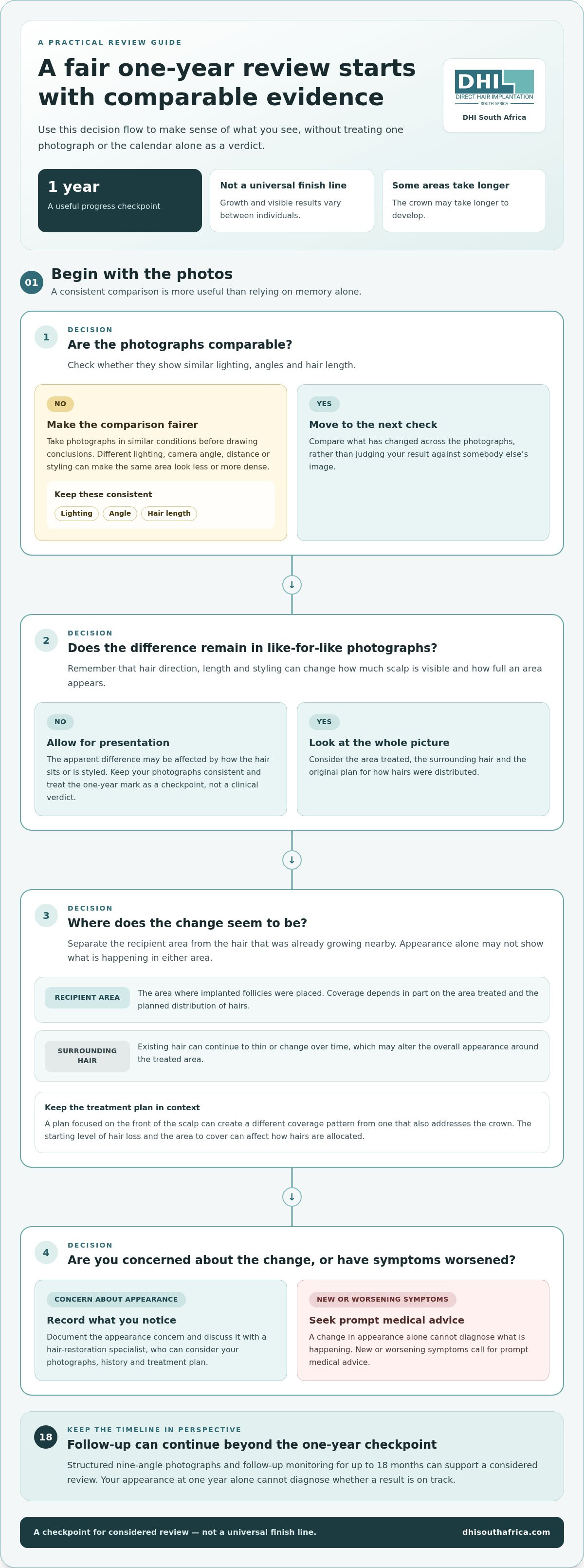
Choose baseline and follow-up photographs taken from similar angles, at a similar distance and in comparable lighting. Keep your hair length and styling as close as possible. A changed parting, wet hair or strong overhead light can make the scalp look more or less visible. DHI South Africa’s documented nine-angle photographic records provide a structured way to compare views rather than relying on one flattering or concerning image.
Try this simple review:
Gather the record. Put your pre-procedure and follow-up photographs together, including side and crown views if available. Avoid choosing only images that support your first impression.
Check the conditions. Look for differences in angle, lighting, distance, hair length and styling. If these vary, treat the comparison cautiously rather than assuming the change is all due to growth or hair loss.
Review separate features. Consider the hairline, coverage in the treated area and overall appearance as distinct observations. Note what you can see, such as a change in the outline or visible scalp, without deciding what caused it.
Write down questions. Record concerns about coverage, hair direction or changes in surrounding hair, then bring them to a clinical discussion.
Matched photographs are more useful than memory because they reduce the influence of changing light, styling and day-to-day impressions. They still have limits: photographs show appearance, not the full clinical context, so use them as a discussion aid rather than a verdict.
Separate personal expectations from clinical observations
Before reviewing your images, revisit the goals discussed for your treatment. You may have hoped for a softer hairline, more coverage in a particular area or a change in how you style your hair. Write those aims separately from what the photographs show. This helps distinguish a result that differs from your personal expectation from a specific observation that needs clinical interpretation.
For example, you might note that the front looks fuller in comparable photographs while the crown remains a concern. That is more useful to discuss than a general feeling that the transplant “hasn’t worked”. A specialist can consider your questions alongside your treatment plan and the changes visible over time.
DHI South Africa’s hair transplant results show individual outcomes, not a promise that your result will look the same. Use them as context, then focus your review on your own photographs, goals and clinical assessment.
What to do if your one-year hair transplant concerns you
It can be unsettling to reach the one-year mark and feel that your appearance doesn’t match what you expected. A concern is worth discussing, but it doesn’t by itself establish what has caused the difference. Start by recording what you’ve noticed, comparing photographs taken under similar conditions and arranging a clinical discussion for an individual assessment.
Prepare for a useful clinical review
Before the discussion, gather dated photographs from before treatment and during follow-up. Add a brief note describing what looks different, when you first noticed it and whether it has changed since. Specific observations, such as “the area looks less covered in recent images” or “the surrounding hair seems finer”, can help focus the conversation without making assumptions about the cause.
It may also help to revisit the goals and treatment plan discussed before the procedure. Make a short list of questions about coverage, hair direction or changes in nearby hair. Bring your notes even if your concern seems small. A review lets a specialist interpret your progress in context; it doesn’t mean further treatment will be recommended or needed.
DHI South Africa documents post-procedure monitoring for up to 18 months. This provides relevant context for a discussion around the one-year point, when a specialist can consider your photographs and observations alongside your individual treatment history. The purpose is to understand your result, not to judge it by a universal standard.
When not to rely on photographs alone
Photographs can show changes in appearance, but they can’t assess how your scalp feels or establish the cause of a symptom. If you have pain, inflammation or another new or worsening symptom, contact a qualified clinician for advice rather than relying on images or online comparisons. A photograph cannot replace an appropriate clinical assessment.
Keep the distinction clear: a concern about how coverage looks can be recorded and raised at a review, while new or worsening symptoms call for prompt medical advice. If you’re unsure which applies, describe what you’re experiencing to a clinician and let them guide the next step. Don’t diagnose a complication from a photograph, and don’t start, stop or change medication without guidance from the clinician responsible for your care.
For a considered discussion about what to expect 1 year after hair transplant surgery, bring your dated images, notes and questions together. This gives the specialist a clearer basis for assessing what you’ve noticed and explaining what it may mean for you.
How DHI South Africa supports a considered hair transplant review
Once you’ve compared your photographs and noted your questions, a specialist can help put your observations into context. At DHI South Africa, a review considers your visible result alongside the original treatment plan, rather than treating one photograph or a general timeline as a diagnosis. It’s a measured way to discuss what you’re seeing and what, if anything, may be appropriate next.
Direct Hair Implantation uses a single-step implantation system that allows control over the angle, depth and direction of implanted hairs. These details are part of the method, but they don’t determine an identical result for every person. Your treatment plan and individual assessment remain central to understanding your progress. The hair transplant treatment information explains more about the approach.
What a specialist-led review can help clarify
A specialist can discuss how your current appearance relates to the intended treatment areas and the distribution of hairs in your original plan. They can also consider dated photographs and your concerns about coverage, hair direction or surrounding hair. This may help distinguish a change in appearance from a question that needs further clinical assessment.
Suitability and next steps are individual. A concern at the one-year point doesn’t automatically mean you need another procedure or a particular treatment. A review is an opportunity to understand your observations, discuss your goals and consider options only if they are relevant to your circumstances.
A measured next step for your personal result
Bring photographs from different stages of your progress, along with a concise list of questions. If possible, include images taken from comparable angles and under similar conditions. DHI South Africa documents nine-angle photographic records for before-and-after comparison, which can provide a more structured view than memory alone. Post-procedure monitoring is documented for up to 18 months, offering relevant follow-up context around the one-year milestone.
If you’re still considering what to expect 1 year after hair transplant surgery, remember that the date is a useful point for discussion, not a pass-or-fail test. A specialist can interpret your observations against your treatment plan and explain what they may mean for you, without assuming that further treatment is required.
A personalised discussion can also help you explore whether Direct Hair Implantation is suitable for your circumstances. You don’t need to arrive with a diagnosis. Your photographs, questions and treatment history are a practical place to begin.
Discuss your hair transplant progress with a DHI specialist
Take your next step with confidence
The one-year point can be a moment to pause and decide what would help you feel more informed. Rather than reaching a firm conclusion from appearance alone, use your questions to guide a conversation about your individual goals and circumstances. A clear understanding of your options can help you decide what feels right, whether that means continuing to monitor your progress or exploring hair restoration further.
If you’re still considering what to expect 1 year after hair transplant surgery, remember that your experience is personal. You don’t need to have all the answers before seeking clarity. Sharing what matters to you is a practical first step towards a considered decision.
Give yourself room to make that decision thoughtfully. With the right information and an individual perspective, you can move forward with greater confidence.
Frequently Asked Questions
Can transplanted hair fall out after one year?
Yes, a transplanted hair can shed as part of its normal growth cycle, but shedding of a hair shaft doesn’t necessarily mean the follicle has stopped producing hair. If you’re wondering what to expect 1 year after hair transplant surgery, note whether the change is occasional or persistent and whether it affects a particular area. A clinician can assess ongoing or marked loss rather than relying on appearance alone.
Is it normal for the hair around a transplant to keep thinning?
Yes, hair that wasn’t transplanted can continue to thin, depending on the underlying cause of hair loss. You might notice the transplanted area looks more prominent while nearby hair gradually becomes finer. That change doesn’t establish the cause by itself. If you see a continuing difference, note when it began and discuss it with a clinician, who can consider the pattern and your hair-loss history.
Can I have another hair transplant after one year?
Possibly, but reaching one year doesn’t automatically mean another procedure is suitable. A specialist needs to assess your current result, the pattern of hair loss, the available donor hair and your goals before discussing options. A concern about the crown, for example, may need a different assessment from one about the hairline. A review can clarify suitability; it doesn’t mean another operation will be recommended.
Why does my transplanted hair look thinner in some photographs?
Camera conditions can make hair appear less full without indicating a change in the result. A close-up image may show more scalp than a photograph taken from further away, while a parting, damp hair or overhead lighting can alter how strands fall. For a useful comparison, look at several images rather than the most concerning one, and check whether your hair was styled similarly.
Do I need to keep taking hair-loss medication after a transplant?
That depends on your individual treatment plan and medical history. A transplant doesn’t determine whether medication is appropriate for hair that wasn’t transplanted, and the right choice varies from person to person. Don’t stop, restart or change a prescribed medicine based on a photograph or general advice. Discuss its purpose, benefits and possible concerns with the clinician who prescribed it or is overseeing your care.
Does transplanted hair need a different washing routine after one year?
Usually, once your clinician’s post-procedure care instructions have ended, transplanted hair can be washed as part of your ordinary hair routine. Use a method that feels comfortable for your scalp, and avoid vigorous scrubbing if it causes irritation. If you’re still following specific aftercare guidance, or washing brings on discomfort or a noticeable scalp change, ask your clinician whether your routine should be adjusted.


Comments