%20(1).jpg)
%20(1).jpg)
Managing Hair Transplant Expectations: A Clear Guide

What if the best hair transplant result isn’t the one that matches an idealised photograph, but the one planned around your hair, donor supply and goals? If you’re managing expectations for hair transplant results, it’s natural to wonder how much visible coverage may be achievable and feel uncertain when early changes don’t match the outcome you imagined.
Progress isn’t the same as a final result. Transplanted hairs can change before their growth becomes easier to assess, so an early appearance doesn’t tell the whole story. A personalised specialist assessment can help set realistic goals by considering your hair characteristics and clinical suitability, rather than promising a particular hairline or density.
This guide explains the factors that shape results, what to look for as your hair changes over time, and how consistent photographs can help you review progress more objectively. DHI South Africa documents follow-up with photographic records and monitoring for up to 18 months, giving you a clearer basis for discussing changes with your specialist. You’ll also learn how to use reference photos and prepare practical questions about what may be realistic for you.
Table of Contents
Managing Expectations for Hair Transplant Results Starts with Realistic Goals
A hair transplant can add hair to selected areas and improve the appearance of coverage, but it can’t recreate unlimited original density. The plan depends on your individual assessment, including your donor area, existing hair and priorities. It’s understandable to have a clear picture of the change you hope to see. The key is to discuss that desired look alongside what your clinical assessment indicates may be achievable, rather than treating a photograph or a particular density as a promise.
Realistic expectations are individual, evidence-informed goals that reflect your starting point, hair characteristics and clinical suitability. This keeps the focus on a meaningful improvement planned for your circumstances, not a standard result everyone should expect. For context on the procedure and its potential outcomes, see this overview of hair transplantation.
For another perspective on expectations and suitability, you can watch this video:
What can a hair transplant change, and what can it not promise?
Implanted follicles can add hair to areas identified in your plan, subject to specialist assessment. The aim is often to create a visible improvement in coverage or the framing of the face, not to reproduce the fullness or hairline you had when you were younger. There isn’t one density figure that defines a successful outcome for everyone. Hair characteristics, the area being treated and available donor hair all shape the plan.
That distinction matters when you’re managing expectations for hair transplant results. A desired appearance is a useful starting point for discussion; clinical suitability helps determine what can responsibly be planned. You can explore how hair transplant treatment is approached at DHI South Africa as part of that conversation.
Why the same result can mean different things to different people
Hair texture, colour, styling habits and the way your hair naturally sits can all influence how much coverage appears day to day. Someone seeking a softer frame around the face may value a different change from someone hoping to style their hair away from the forehead. Your starting point matters too: before-and-after photographs are most useful when they show comparable angles, lighting and hair presentation.
Rather than asking for a celebrity’s hairline, describe what you want to change in practical terms. Explain which area draws your attention, how you usually wear your hair and what would feel like a worthwhile improvement. Those details help a specialist discuss a design suited to your features and donor capacity, instead of comparing your likely outcome with someone else’s photograph.
Hair Transplant Results Over Time: How to Read Each Stage
Visible change after a hair transplant is best understood as a process, not a fixed calendar. Your appearance may look different at various points, and the pace and pattern of change can vary between individuals. That can make early comparisons unsettling, especially if you’re hoping for a clear sign that progress is on track. Focus on changes across a series of observations, interpreted in light of your own treatment plan.
One photograph can capture a moment, but it cannot establish a final result. An early image may show a transitional appearance rather than the outcome you’ll eventually be able to assess. Healing and recovery follow their own clinical guidance; this section focuses on judging visible changes, not managing post-procedure care.
Which changes should patients track over time?
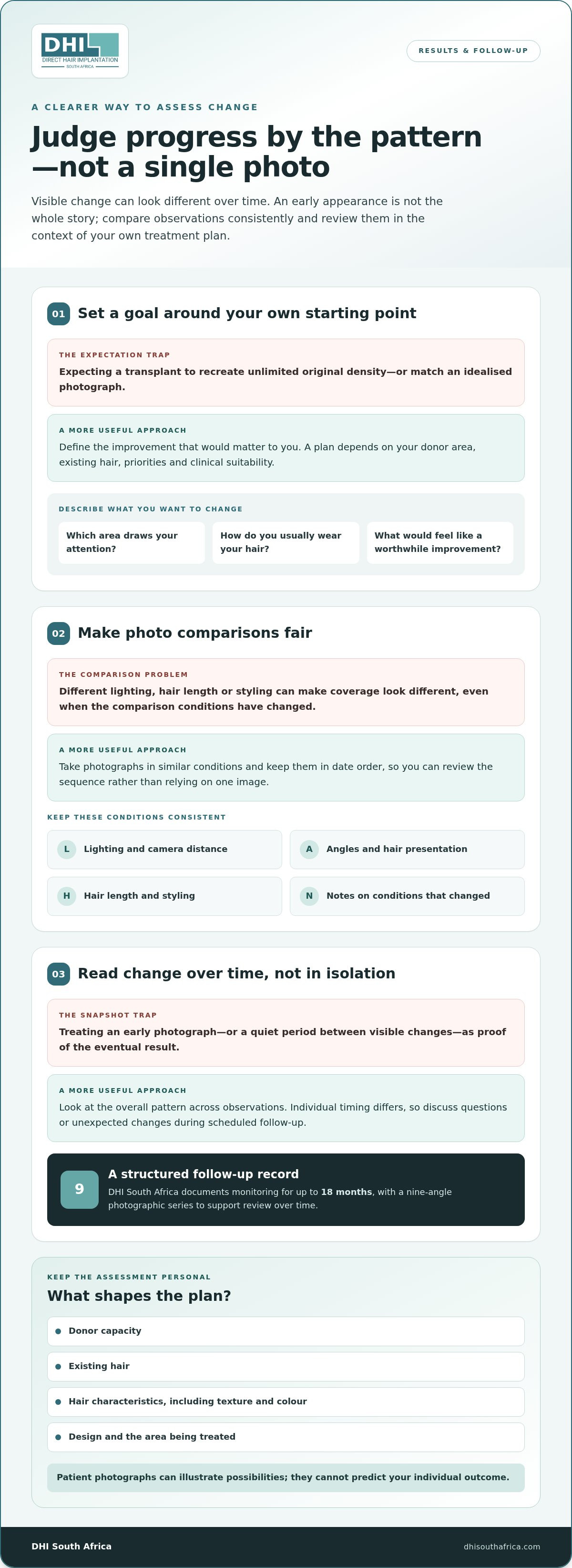
Use consistent photographs to make comparisons more meaningful. Aim for similar lighting, camera distance, angles and hair length, and present your hair in a similar way each time. If one photo is taken in bright overhead light with damp hair and another in softer light with dry, styled hair, the difference may reflect the conditions rather than a change in coverage.
Look at the overall pattern rather than scrutinising a single spot or image. Changes may be gradual, and individual timing differs, so a quiet period between noticeable changes doesn’t automatically explain what is happening. Follow the clinical guidance provided for your care, and raise unexpected changes or concerns during your scheduled follow-up. Your clinician can consider them in context instead of relying on a snapshot alone.
Keep photographs in date order so you can review the sequence.
Note any differences in lighting, hair length or styling that could affect comparison.
Write down what you notice and the questions you want to discuss at follow-up.
When should progress be reviewed with a specialist?
Use the follow-up plan set for you rather than comparing your progress with a universal deadline. Your clinician can interpret photographs alongside your treatment plan and personal circumstances, helping distinguish expected variation from a change that needs discussion. DHI South Africa documents follow-up monitoring for up to 18 months, with a nine-angle photographic series to support review over time.
Managing expectations for hair transplant results also means treating patient images as illustrations, not predictions. Starting points, hair presentation and individual plans differ, so another person’s photographs cannot determine your outcome. DHI South Africa’s hair transplant results offer examples to view with that context in mind. Bring questions about what you see to your scheduled clinical follow-up, where images can be considered alongside your own progress.
What Shapes Hair Transplant Results More Than a Single Hair Count?
A hair count matters, but it can’t tell you by itself how much coverage will appear or whether a planned design suits your features. A specialist considers how much donor hair is available, where your existing hair sits, your hair characteristics and how the target area should be designed. These factors work together, so two people with the same number of planned hairs may have different-looking results.
Ongoing hair loss is also relevant to planning. Existing hair may continue to change, but its future pattern can’t be predicted with certainty for an individual. A plan should take your current situation and longer-term considerations into account, rather than treating one hair count or one technique as a complete answer.
How do donor area and existing hair affect achievable coverage?
The donor area is the region from which follicles are taken for implantation. Its available hair must be assessed in relation to the area being treated: a larger target area and limited donor supply may call for different priorities from a smaller area with more donor capacity. Planning involves balancing these considerations, not simply assigning a high number of hairs to every area of concern.
Your existing hair matters too. Its distribution can affect how added coverage blends with the surrounding areas and where a change may be most noticeable. For example, a plan focused on a particular part of the hairline may create a different overall impression from one that spreads attention across a broader area. The appropriate balance depends on your individual assessment.
Ask how the proposed plan accounts for both the donor area and the hair already present. This can help you understand why the specialist prioritises certain areas and how the planned number of hairs relates to your goals, rather than viewing the count in isolation.
How do hairline design and hair characteristics influence the result?
Hairline design is about more than choosing a position. Direction, angle and placement help shape how implanted hair sits alongside existing growth. Hair characteristics, including texture and colour, also influence how much fullness is perceived. These details help explain why a design that looks appropriate in one person’s photographs may not be right for another.
DHI uses a patented, single-step implantation system that gives the specialist control over angle, depth and direction. That precision is one part of the process, not a guarantee of a particular appearance. Technique alone cannot determine the visible result; it needs to be considered alongside donor capacity, existing hair and an individualised design. The Direct Hair Implantation approach is one element of this broader planning discussion.
For a useful assessment conversation, focus on the area you want to address and the practical change you hope to see. Ask how your hair characteristics, donor capacity and current pattern inform the proposed design. This makes managing expectations for hair transplant results more specific than relying on a single count or comparing techniques by name alone.
How to Set and Review Your Hair Transplant Expectations
A focused discussion helps turn a broad hope for “more hair” into goals you and your specialist can assess together. Before your assessment, think about the areas that matter most in your everyday appearance, the change you’d value and any concerns that might affect your decision. Be open about the possibility that hair loss may continue, so longer-term planning can take account of your current hair as well as the area being treated.
Use this short checklist to organise your thoughts:
Priority area: Which part of your scalp most affects how you feel about your appearance?
Desired change: What would you like to look or style differently?
Concerns: What feels uncertain, including the possibility of ongoing hair loss?
Questions: What do you want to understand about suitability, likely changes and follow-up?
These prompts can make managing expectations for hair transplant results more personal and practical. They also give your specialist a clearer sense of what matters to you, while leaving room to discuss what your assessment indicates may be suitable.
What should you bring into a results discussion?
Reference images can help explain a look you like, but treat them as conversation aids, not exact templates for a promised outcome. Point out what appeals to you, such as a softer hairline or more coverage in a particular area. Then ask how your own hair, donor capacity and treatment plan affect what may be achievable. Clear questions make it easier to understand both the proposed changes and their limits.
Prioritise the areas that make the greatest difference to your day-to-day appearance, rather than trying to address every concern at once. Ask how ongoing hair loss may influence longer-term planning, which changes the treatment aims to create, and how your progress will be reviewed. It’s reasonable to discuss uncertainty directly; an informed plan should make space for questions, not rely on assumptions.
How can before-and-after photographs be compared fairly?
Compare images taken from similar camera angles and distances, in comparable lighting, with hair presented at a similar length and in a similar style. These details matter: a change in lighting or styling can alter the impression of coverage. Check when each image was taken, too. A single comparison can’t show the full course of change or establish what another person’s outcome means for you.
Documented photographs can support a more objective review when they’re considered alongside your individual treatment plan and clinical follow-up. They’re useful records, not guarantees that your appearance will match someone else’s. If images seem inconsistent or raise questions, note what differs and discuss it during your planned review rather than drawing a conclusion from one photograph.
A personalised hair restoration assessment can help you discuss your goals and how they relate to your individual circumstances.
How DHI South Africa Approaches Hair Transplant Results and Follow-Up
Clear expectations begin with a plan built around you. Before treatment, a specialist assessment considers your hair loss, donor area and personal goals, then relates them to clinical suitability. This helps distinguish the change you hope for from the approach that can be planned for your circumstances. It also gives you a chance to discuss priorities and understand why a particular area or design may be recommended.
Why is a personalised assessment central to realistic expectations?
Your suitability and proposed plan are specific to you. An assessment considers the hair available in the donor area alongside the areas you want to address and the appearance you hope to achieve. This individual picture is more useful than relying on a standard hair count or another person’s result. For more about the procedure itself, DHI South Africa’s hair transplant treatment information provides additional context.
Discussing goals openly helps the specialist explain how the plan relates to your clinical assessment. You can identify which area matters most, describe how you usually wear your hair and ask what changes may be reasonable to plan for. If your hopes and the clinical assessment don’t align exactly, that conversation can help clarify the options and the considerations behind them.
How can structured follow-up support a clearer view of progress?
After treatment, DHI South Africa documents progress through monitoring for up to 18 months and a nine-angle photographic record. Consistent views can make gradual changes easier to review than relying on memory or occasional snapshots. These records support discussion with your care team, but they don’t promise a particular appearance or mean every patient’s progress will look the same.
At follow-up, photographs can be considered alongside your individual plan, and you can raise questions about what you’re seeing. If images appear different, factors such as angle, lighting or hair presentation may affect how they look. Reviewing the sequence with your care team offers more context than drawing a conclusion from one image. Monitoring supports understanding; it doesn’t guarantee a specific outcome.
Good follow-up is part of managing expectations for hair transplant results. It creates a planned opportunity to discuss your progress and any concerns, rather than leaving you to interpret every change alone. Keep notes between reviews: record what you’ve noticed, when it changed and what you’d like to ask. Specific observations can make conversations more useful and keep the focus on your own treatment journey.
A personalised approach brings assessment, implantation and follow-up together. DHI’s single-step implantation system allows control over angle, depth and direction, supporting careful placement as part of the treatment process. Precision matters, but it cannot determine an individual result on its own. Your suitability, personal characteristics and plan remain central to how an outcome may look.
Take the Next Step Towards a Plan That Feels Right for You
Choosing whether to pursue hair restoration is a personal decision, and you don’t need to have every answer before starting a conversation. A useful next step is to describe what you’d like to change, what you’re unsure about and what would help you feel informed. That gives a specialist a practical starting point for discussing your circumstances, rather than relying on an imagined outcome alone.
Thoughtful managing expectations for hair transplant results means making space for both hope and honest clinical guidance. You can ask how your priorities might shape a plan, what factors could influence suitability and how you’ll review progress. The aim is to leave with a clearer understanding of your options, not pressure to make an immediate decision.
Take the time you need to consider what matters to you. A well-informed conversation can help you move forward with greater confidence and expectations grounded in your individual needs.
Frequently Asked Questions
When can I judge the results of a hair transplant?
Judge the result according to your clinician’s follow-up plan, rather than a date that applies to everyone. Hair changes can take time to become clear, and early appearance may not reflect the eventual outcome. If you’re unsure whether a change is expected, note when you noticed it and raise it at your next review. Managing expectations for hair transplant results means assessing progress in the context of your individual treatment plan.
Is it normal for hair transplant results to look uneven at first?
Some unevenness in appearance can occur during changing stages of growth, as different areas may not look the same at the same time. Styling, hair length and the way light falls can also make coverage seem less balanced. Try not to judge the result from one day or one area alone. If you notice a change that concerns you, discuss it with your care team during follow-up.
Can a hair transplant restore my original hair density?
A hair transplant can’t be assumed to restore the density you had earlier in life. The plan depends on your available donor hair, the area being treated and the appearance you hope to achieve. A specialist can explain how these factors shape a suitable plan for you. It can help to discuss which area matters most, rather than expecting every part of the scalp to have the same density.
What happens if my hair continues to thin after a transplant?
Hair loss may continue to affect hair that wasn’t transplanted, so ask your specialist how this possibility relates to your longer-term plan. If you notice thinning in other areas, make a note of where and when it appears, then raise it at a clinical review. Your care team can consider the change alongside your treatment history and discuss what options may be appropriate for your circumstances.
How should I compare hair transplant before-and-after photos?
Start with your own baseline photographs and compare them with later images, rather than using another person’s result as a prediction. Check that images haven’t been filtered or edited, and note the dates so you can understand the interval between them. Review a series rather than drawing a conclusion from one pair. If a difference is difficult to interpret, take the images to your scheduled follow-up for discussion.
Will transplanted hair keep growing naturally?
Transplanted follicles are intended to grow hair in the treated area, but how the result develops varies between individuals. Once growing, the hair can generally be washed, cut and styled as part of your usual routine, following any clinical advice you’ve received. Hair can also change in colour or texture as you age. Your specialist can advise what to expect based on your treatment and personal circumstances.
Do I need a second hair transplant if I am not satisfied with the result?
Not necessarily. First discuss what feels unsatisfactory with your specialist and review your progress in line with your follow-up plan. A further procedure is not an automatic next step: a clinician would need to assess your current hair, donor capacity, goals and suitability. It may also help to identify whether your concern relates to coverage, design or continued thinning, since each calls for a different discussion.


Comments