%20(1).jpg)
%20(1).jpg)
Can a Hair Transplant Fail? Causes, Signs & Advice for 2026

Could a hair transplant look as though it has failed while recovery is still underway? If you’re asking “can a hair transplant fail”, yes, but early disappointment doesn’t automatically mean the procedure has failed. Uncertainty can be difficult, especially when you’re watching for signs that transplanted hairs are growing as expected.
Some transplanted hairs shed in the first few weeks before new growth begins, so changes in the mirror need to be understood in context. Results develop gradually, and judging them too soon can cause unnecessary concern.
This article explains what partial or complete failure can mean, why outcomes may vary, and how planning, technique and aftercare can influence the result. It also covers the recovery timeline: shedding commonly occurs within the first 2-8 weeks, new growth may begin around the third or fourth month, and final results generally need 12-18 months to assess. Rather than trying to diagnose the outcome from photographs alone, you’ll learn how consistent photo follow-up and an individual clinical assessment can help clarify what’s happening and what to discuss next.
Table of Contents
Can a hair transplant fail? What failure means in practice
Yes, a hair transplant can fall short of what you and your clinician planned. That might mean fewer transplanted hairs becoming visible than expected, uneven coverage, or a hairline that doesn’t look natural to you. But concern during recovery, or disappointment at one stage, isn’t enough on its own to establish that the procedure has failed.
It helps to separate three different outcomes. Limited growth concerns how many transplanted hairs become visible. Low density describes how full an area looks, which can depend on both the planned number and distribution of hairs and how they grow. Unnatural appearance relates to how the hairline or direction of growth looks. These concerns may overlap, but they aren’t interchangeable, and one doesn’t automatically explain another.
What does a failed hair transplant mean?
In practical terms, failure may describe growth or appearance that falls short of the agreed clinical plan once the result has been properly assessed. Partial failure means some transplanted hairs grow, but coverage or appearance remains below expectations. Complete failure means there is little or no visible growth from the transplanted area. The distinction describes the extent of the concern, not its cause.
As a simple guide: partial failure means some transplanted hairs grow, but the result falls short; complete failure means little or no visible growth. The Hair transplantation overview describes the procedure and its techniques, but a general explanation can’t determine what has happened in an individual case. Appearance alone cannot show whether the issue relates to planning, healing, follicle handling or another factor.
Why early uncertainty does not prove failure
Assessment needs to consider what was planned for your hairline and coverage, the number and placement of hairs, and how the area has changed over time. There isn’t one visual cue that settles the question for everyone. A clinician can review the procedure details alongside consistent photographs and your recovery history, then explain whether the result appears to be developing as expected or warrants closer review.
If you’re exploring DHI hair transplantation in South Africa, individual planning can provide a reference point for assessing the result later. If you’re already concerned about a transplant, bring your questions to an individual clinical assessment instead of trying to assign a cause from photographs alone. This turns uncertainty into a clearer discussion about what you’re seeing and what to consider next.
Why can a hair transplant fail? Causes that may affect the result
If you’re wondering, can a hair transplant fail, look beyond one visible change. The result can be shaped by the original plan, how follicles are handled and placed, individual health factors, and recovery care. These influences may overlap, so a disappointing appearance doesn’t reveal the cause by itself.
A transplant result can reflect several interacting factors, rather than one assumed cause. A clinical review should consider the intended design, the procedure and your recovery instead of assigning blame based on appearance alone.
Planning, placement and follicle handling
A hairline needs to suit your features and take account of the hair available for redistribution. The planned number and distribution of hairs affect how coverage appears. Even when hairs grow, an area may look less dense than expected if the design or placement doesn’t create the intended visual balance. A hairline that feels too low, too straight or uneven raises a different concern from limited growth.
Follicles also need careful handling throughout the clinical procedure. They are living tissue, and how they are managed and placed forms part of the overall result. In DHI, the Implanter is used to control placement, including hair angle, depth and direction. This describes a feature of the method, not a promise of a particular result. Individual planning and clinical factors still matter.
Health, ongoing hair loss and aftercare
Your health and scalp condition can be relevant to planning and recovery, so they should be considered in an individual assessment. Another factor is androgenetic alopecia, the medical term for genetically influenced pattern hair loss. A transplant relocates selected follicles, but it doesn’t stop this pattern from progressing in untreated hair. As surrounding hair changes, the overall density or balance may look different even if transplanted hairs are present.
Transplanted follicles are autologous tissue, meaning they come from your own body. That differs from receiving tissue from another person, so routine “rejection” is not a sound explanation to assume from a photograph. If growth seems limited, a clinician needs to assess the facts rather than label it as the body rejecting its own follicles.
Aftercare is another part of the picture. Following the instructions provided for your recovery supports appropriate care of the treated area. If you’re unsure whether something you did affected healing, share it openly during review. The aim is to understand what happened, not to blame you. A clinician can weigh aftercare alongside planning, health and procedural details before discussing likely causes.
If you’re considering a procedure, understanding DHI hair transplant planning can help explain how placement decisions relate to the intended appearance. For an existing concern, bring your timeline and specific observations to a clinical assessment. A considered review is more useful than drawing conclusions from one factor in isolation.
How to tell whether hair transplant changes need clinical review
Noticing sparse areas, uneven coverage or a hairline that seems to grow in an unexpected direction can be unsettling. These observations are worth discussing, but they don’t prove that follicles have failed or explain why the area looks that way. Recovery and visible changes vary, so a useful next step is to record what you’re seeing and review it with a clinician in context.
Use this guide to decide what to note and when to request an assessment. It isn’t a diagnostic checklist. If you’re wondering, “can a hair transplant fail?”, photographs and observations can help start a conversation, but they can’t settle the answer on their own.
Observation: Some areas appear sparse or have persistent-looking gaps.Why it may be uncertain: A photograph captures one moment. It can’t show whether growth is still developing or how the area compares with the agreed plan.When to request assessment: Discuss it if the gaps remain a concern over time or seem inconsistent with the planned coverage.
Observation: Density looks uneven across the treated area.Why it may be uncertain: Hair length, styling, lighting and camera angle can change how coverage appears. The distribution of hairs in the original plan also matters.When to request assessment: Share consistent photographs with your clinician if unevenness persists or concerns you.
Observation: Hairline hairs seem to point in an unexpected direction, or the outline differs from the design discussed.Why it may be uncertain: A single view may not show the overall shape, and appearance alone can’t establish the cause.When to request assessment: Ask for a review if the direction or outline continues to trouble you, and refer to the original plan if you have it.
Which changes may warrant a closer look?
Persistent gaps, uneven density or a visible difference from the planned hairline are reasonable topics for review, particularly if they remain apparent in photographs taken consistently. A visible concern is not proof that follicles have failed. Describe what you notice and ask for the result to be assessed against your procedure details and recovery history.
When can a result be assessed reliably?
Assessment timing depends on the procedure, your recovery and the changes observed. General time ranges can offer context, but shouldn’t be treated as a universal deadline for every patient. Your clinician can advise when a review will be informative and whether further follow-up is appropriate.
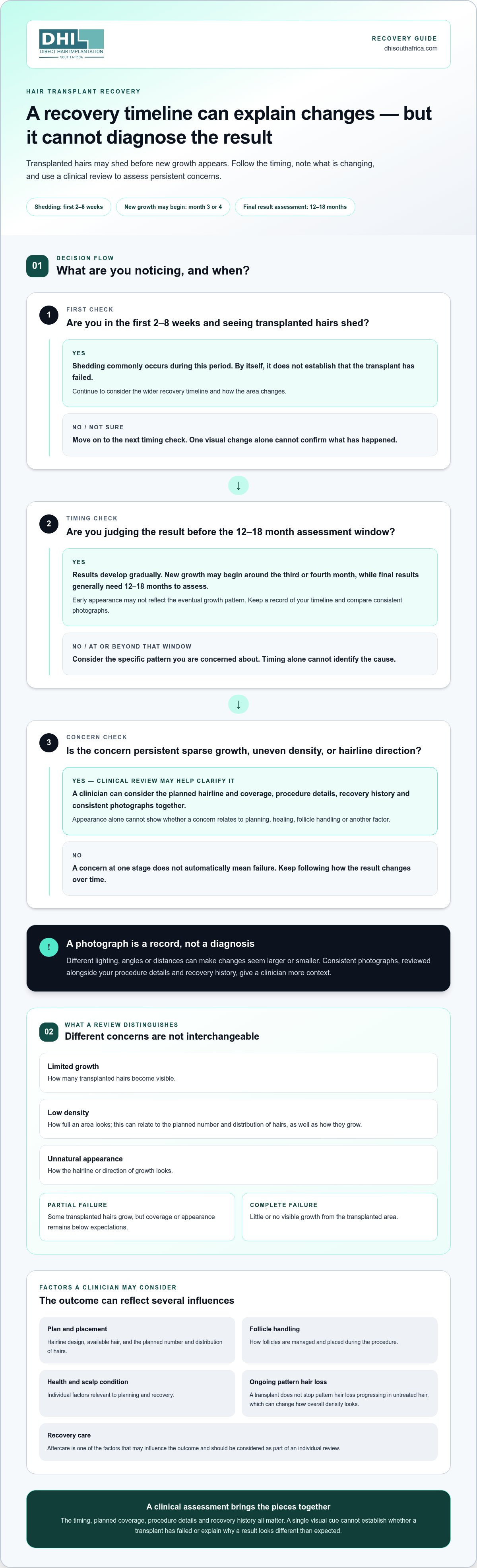
One photograph or an early observation can’t settle the outcome, because it shows only one moment in a changing recovery. Take photographs from similar angles, in comparable lighting and at a consistent distance. Date them and note any changes you’ve noticed. Avoid relying on online comparisons alone, as another person’s hair type, plan, timing and photographic conditions may differ from yours. Structured clinical photographs, including a consistent multi-angle series, can make it easier to discuss change over time. Bring your images and concerns to a specialist review for an individual assessment.
What to do if you think your hair transplant has failed
It can be upsetting to feel that your result hasn’t met expectations. You don’t need to work out the cause on your own. A calm, structured review can help distinguish what you’re noticing from what may be happening clinically, and clarify whether monitoring or another discussion is appropriate.
If you’re asking, “can a hair transplant fail?”, gather useful information rather than making a decision from one photograph or impression. These steps can help you prepare for a focused assessment.
Record what concerns you. Note when you first noticed the change, which areas are involved and whether it seems stable or has changed. Be specific: for example, you might be concerned about sparse coverage near the front, uneven density across an area, or the direction of hairs along the hairline.
Gather dated photographs and procedure details. Bring photographs from different stages of recovery, ideally taken from similar angles and in comparable lighting. If available, include your procedure records, the original plan and any aftercare instructions. Note the steps you followed and anything you’re uncertain about, without assuming it caused the outcome.
Arrange a clinical review. Share your timeline, images and questions with a clinician who can assess your situation in context. An individual hair transplant treatment plan depends on clinical findings, not just how dense an area appears in a single image.
Prepare for a useful clinical assessment
Write down your main questions before the appointment. For instance: Is the growth developing as expected for my recovery? How does the current density compare with the planned distribution of hairs? Could changes in untreated hair affect the overall appearance? Which details of my procedure or aftercare are relevant? Clear questions make it easier to focus on the concerns that matter most to you.
Bring the original timeline if you have it, and describe what has changed since then. If you’ve compared your result with online photographs, remember that differences in hair type, lighting, styling, treatment plan and recovery stage make direct comparisons unreliable. Your own dated images and records are more useful for a personal review.
What may be discussed after the assessment?
The clinician may recommend continued monitoring, explain factors that could contribute to the appearance, or discuss possible next steps. Further treatment is not automatic. Any decision depends on the likely cause, the available donor hair and your individual suitability. A further procedure may not be appropriate, and no option should be presented as a guaranteed solution.
If an additional approach is considered, ask how it relates to your specific findings, what it is intended to address and what limitations may apply. The aim is a clear, realistic discussion, not a rushed decision. You should leave understanding what has been assessed and what the proposed next step is.
How DHI approaches hair transplant planning and follow-up
A considered plan and consistent follow-up can clarify the purpose of treatment before the procedure and help review changes as they develop. They don’t guarantee a particular result. If you’re still asking, “can a hair transplant fail?”, it’s useful to understand what a documented approach can support: deliberate placement, defined safety processes and a record that helps clinicians review progress over time.
How controlled DHI implantation supports planning
DHI uses a single-step implantation system with the DHI Implanter, an instrument used to place hairs with control over their angle, depth and direction. These details matter to the planned design. The direction of hairline hairs, for example, contributes to how the result looks, while distribution relates to the intended coverage. Planning considers the individual rather than treating density as a one-size-fits-all target.
This control describes the method, not a promise that every hair will grow or that every person will achieve a particular density or appearance. An individual assessment helps determine whether the plan is appropriate and how it relates to your hair, donor resources and goals. If you’re exploring the technique, DHI’s Direct Hair Implantation approach provides context on the procedure and its planning.
Safety processes are another part of the documented approach. DHI’s protocol includes 18 mandatory clinic safety checks and single-use instruments. These measures form part of the clinic’s procedures; they don’t make any medical treatment risk-free or predict an individual outcome. A clear discussion of the plan and relevant health information remains important to care tailored to you.
Why structured follow-up matters
Recovery can be difficult to judge from memory. A structured photographic record gives clinicians a consistent way to compare the appearance of treated areas across follow-up visits. DHI documents a nine-angle before-and-after photo series, helping capture views that a single front-facing image may miss. Consistent images can support discussion of visible changes, but need to be interpreted alongside your timeline and clinical assessment.
DHI also documents monitoring for up to 18 months. This describes the documented follow-up approach, not a promise that every patient will have an identical schedule or that a result can be judged in the same way for everyone. The timing and focus of review depend on the individual case. Bring questions about growth, coverage or appearance to your clinician, who can consider the photographs alongside your procedure and recovery history.
If you’d like to understand how planning and follow-up may apply to your circumstances, you can request an individual hair-restoration assessment. A careful review can help clarify your options without assuming the cause or promising a specific result.
Take the next step with a clearer picture
Uncertainty about your result can be hard to carry, but you don’t have to decide by yourself what it means. The question “can a hair transplant fail” is best answered in the context of your own procedure, recovery and goals, not through a quick comparison with someone else’s photographs.
A clinical conversation can help turn concern into a plan. Explain what has changed, what you hoped to achieve and what you’d like clarified. An assessment can then focus on your individual circumstances and the options that may be appropriate, without assuming the cause or rushing you towards a decision.
Frequently Asked Questions
Can a hair transplant fail because the body rejects the transplanted hair?
Immune rejection is not usually the first explanation considered after a transplant using your own follicles. If the scalp becomes increasingly red, painful or swollen, or develops discharge, seek prompt medical advice rather than assuming the cause is rejection. A clinician can examine the area and decide whether a complication or another issue needs attention. Don’t start or stop medication based only on online advice or photographs.
Can a hair transplant fail years after the procedure?
A concern can become noticeable years later, but the timing alone can’t show whether the original procedure has failed. Changes in scalp condition, hair care or general health may also affect how the area looks and feels. If you notice a new change, note when it began and whether it is progressing. A clinician can compare your current condition with earlier records and advise whether further investigation is appropriate.
Can a failed hair transplant be corrected with another procedure?
In some cases, a revision procedure may be considered, but it isn’t automatically the right solution. Assessment needs to account for the existing result, scalp condition, remaining donor resources and the specific change you want addressed. A clinician may explain potential benefits, limitations and alternatives before recommending a plan. Bring details of previous procedures, including dates and available records, so the discussion can be based on your full treatment history.
Does a hair transplant failure always mean no hair will grow?
No. A person may have visible growth yet still feel that the result does not meet their aesthetic goal, such as a hairline shape that feels out of balance with their features. That differs from having no visible growth and may call for a different discussion about what can realistically be improved. Explain which aspect matters most to you, rather than describing the entire procedure as unsuccessful.
Can hair texture change after a transplant?
Transplanted hair may not look or feel exactly as you expect at every point in recovery. Curl, coarseness and apparent thickness can be influenced by the characteristics of the donor hair and by how the hair is cut or styled. If a noticeable difference persists or concerns you, show the area to a clinician and describe when you first observed it. Avoid changing treatment products to address it without advice.
Can women experience an unsuccessful hair transplant result?
Yes. Women can have a result that does not meet their goals, and careful assessment before treatment is important. The clinician may need to understand the pattern and cause of hair loss, whether it is stable, and how much suitable donor hair is available. For example, diffuse thinning across the scalp raises different planning questions from a clearly defined area. Suitability and expectations should be discussed individually.
Is it possible to assess a hair transplant result from photographs alone?
Photographs are useful records, but they can’t show every feature a clinician may need to assess, such as scalp condition or the feel of the treated area. A clear image can help identify what you want to discuss, while an examination and procedure history add important context. If an in-person review is not immediately practical, ask whether your photographs can help organise an initial discussion, not replace a full clinical assessment.

Comments