%20(1).jpg)
%20(1).jpg)
Styling Tips for Transplanted Hair: A Gentle Guide

The safest styling choice after a hair transplant may be to pause your usual routine while your scalp heals. It’s understandable to wonder whether a brush, product or heat tool could affect recovery, especially when changes in your hair make your appearance feel less predictable. The most helpful styling tips for transplanted hair start with protecting the healing area, then reintroducing styling gradually in line with your specialist’s advice.
There isn’t one calendar that suits every patient. Your healing progress and personalised post-procedure instructions matter more than a general timeline. This guide explains how to approach styling during early healing and later recovery, and how to make considered choices about products, tools and your changing look. DHI South Africa’s structured aftercare includes photographic documentation and post-procedure monitoring for up to 18 months, helping keep guidance connected to your individual progress.
Table of Contents
Why styling transplanted hair needs a different approach
After a hair transplant, keep styling simple and follow your treating specialist’s instructions. Your scalp and implanted follicles need time to heal, so grooming choices that feel comfortable on healed skin may not be suitable during early recovery. Post-transplant styling means adapting your routine to your healing progress and clinical guidance.
That doesn’t mean you need to ignore how you look. Feeling self-conscious about changes in your hair is understandable, particularly when your appearance may differ from what you expected. Gentle choices can help you feel more at ease, but styling cannot speed up hair growth or guarantee a particular result.
What changes after a hair transplant?
Transplantation involves placing follicles in the recipient area, so both the implanted follicles and the surrounding scalp need time to recover. During this process, the area may look or feel different from your usual scalp. Its appearance can also change as your hair and scalp progress through the restoration journey.
Some visible changes are temporary, while longer-term results develop over time. Experiences vary, so don’t treat a particular look or stage as a prediction of your outcome. A mirror shows what is happening today, but it cannot tell you exactly how your individual growth will unfold.
Understanding the hair transplantation techniques and process can help explain why aftercare matters: follicles are placed into the scalp, and early grooming needs to account for healing tissue. Your procedure’s details are relevant too. DHI’s hair transplant approach provides context for the treatment, while your own aftercare guidance should direct your routine.
Why your own aftercare instructions come first
There isn’t one styling rule for every patient. The technique used, the details of your procedure and the way your scalp is healing can all affect your specialist’s recommendations. Advice that suits someone else may not suit your recovery, even if their procedure seems similar.
Use your treating specialist’s instructions as your reference point, rather than relying on a general online timeline or another patient’s experience. If you’re unsure whether a grooming step is appropriate, pause and get guidance from the team overseeing your aftercare. This is especially important if your scalp feels uncomfortable or you notice a change that concerns you.
These styling tips for transplanted hair are general information, not a medical assessment. They can help you think through your routine, but they can’t determine whether your scalp is ready for a particular product, tool or technique. Personalised guidance keeps the focus on your healing, not a one-size-fits-all schedule.
How healing stages shape styling choices after transplantation
Your styling routine should change in step with your recovery, not follow a fixed calendar. Early healing calls for protection and close attention to your clinic’s care instructions. As recovery progresses, your treating specialist can advise when to reintroduce grooming, products or tools. Styling readiness depends on how your scalp is healing and on personalised clinical advice.
This phased approach can make decisions feel more manageable. Rather than switching straight back to your usual routine, introduce each change only when your specialist says it is appropriate. The right time to progress is individual, even if someone else’s experience seems similar.
What to prioritise during early healing
At first, focus on the washing and care instructions provided by your clinic. Follow the recommended method carefully, and avoid improvising because a routine feels familiar or seems gentle. Your guidance should explain how to care for the scalp without unnecessary contact with the treated areas.
Don’t brush, rub, apply styling products or pull the hair into a tight style unless your treating specialist has approved it. Even light handling can involve contact or pressure, so don’t assume a tool or technique is suitable simply because it feels comfortable. If you’re uncertain about a step, leave it out until you’ve received advice.
Contact your clinic if you notice an unexpected or concerning change, rather than trying to address it through styling. A grooming guide cannot assess your scalp or explain a new symptom. Your clinical team can advise whether the change needs attention and what to do next.
How to resume a familiar routine carefully
Once your specialist says you can return to grooming, begin with the simplest change. If you’re cleared to style, for example, try your usual routine without adding a new product and tool at the same time. Reintroducing one habit at a time makes it easier to identify what may cause irritation or discomfort.
Keep each step consistent with your individual instructions. Ask whether brushing, a particular product, heat styling or a haircut is appropriate before using it on or near the treated area. Recommendations can differ according to your procedure and how your scalp is healing, so general advice should never overrule your treating specialist.
If a newly introduced step feels uncomfortable, stop and seek guidance instead of pushing through to finish your style. This isn’t a test of how much your scalp can tolerate. A gradual return gives you room to notice how you respond and adjust with clinical support.
When established styling becomes part of your routine
As your specialist confirms that healing is progressing and approves further steps, you may be able to build towards a more familiar routine. Continue to follow any care instructions that still apply, and don’t treat a return to everyday grooming as permission to use every technique at once. Your own recovery remains the guide.
These styling tips for transplanted hair are most useful when applied flexibly: protect the scalp early, reintroduce habits with approval, and progress according to your clinical guidance. To understand how DHI fits into the treatment journey, explore the DHI hair transplant approach.
Styling products, tools, and techniques: what to consider
A product or tool that suits your usual routine isn’t automatically suitable for a healing scalp. Before using it, consider how much it touches the scalp, whether it pulls or presses on the hair, and whether your treating specialist has approved it. These styling tips for transplanted hair are a decision-making guide, not a universal list of safe products or methods.
The comparison below can help you frame questions for your clinic. It doesn’t rank options or replace your aftercare instructions. A method that feels gentle may still be unsuitable at a particular stage of your recovery.
Choice
What to consider
Clinical caution
Styling products
How they’re applied and whether they touch the scalp.
Follow clinic advice on whether, when and how to use them.
Brushes or combs
The amount of contact, pressure or pulling involved.
Ask when grooming tools are appropriate for your treated areas.
Heat tools
Proximity to the scalp and your usual technique.
Get individual guidance before using heat during recovery.
Tight styles
Whether the style creates tension or pulls on the hair.
Discuss styles that hold hair firmly with your specialist.
Hair products and scalp sensitivity
Your scalp’s response can change as it heals, so a product you’ve used comfortably before may not feel the same during recovery. Application matters too: working a product close to the scalp involves different contact from shaping the lengths of your hair. Don’t assume a product is suitable because it’s familiar, labelled as gentle or recommended to someone else.
Follow your clinic’s instructions about which products to use and how to apply them. If you’re considering a new product, ask your treating specialist whether it fits your current aftercare guidance. Avoid relying on claims that a product can stimulate follicles or improve transplant growth. Styling products should not be treated as a substitute for clinical care.
Heat, brushes, and styling tension
Heat tools, brushes and tension-based styles each involve different kinds of contact. Their suitability depends on your recovery and your specialist’s advice, rather than a blanket rule for every patient. For example, a style that pulls hair away from your face may feel practical, but discuss the tension involved before trying it.
Pay attention to comfort, but don’t use comfort alone to decide whether a technique is appropriate. Follow your clinic’s instructions and pause if a styling step causes discomfort. Ask about the specific tool or method you have in mind so the guidance reflects how you plan to use it.
A gentle routine for styling transplanted hair
A calm, repeatable routine can make getting ready feel less uncertain. Keep it flexible: start with your clinic’s current instructions, then decide whether each step is appropriate for your scalp today. The aim isn’t to create a particular look at any cost. It’s to groom without ignoring your recovery or going beyond the guidance you’ve been given.
A simple check-before-you-style sequence
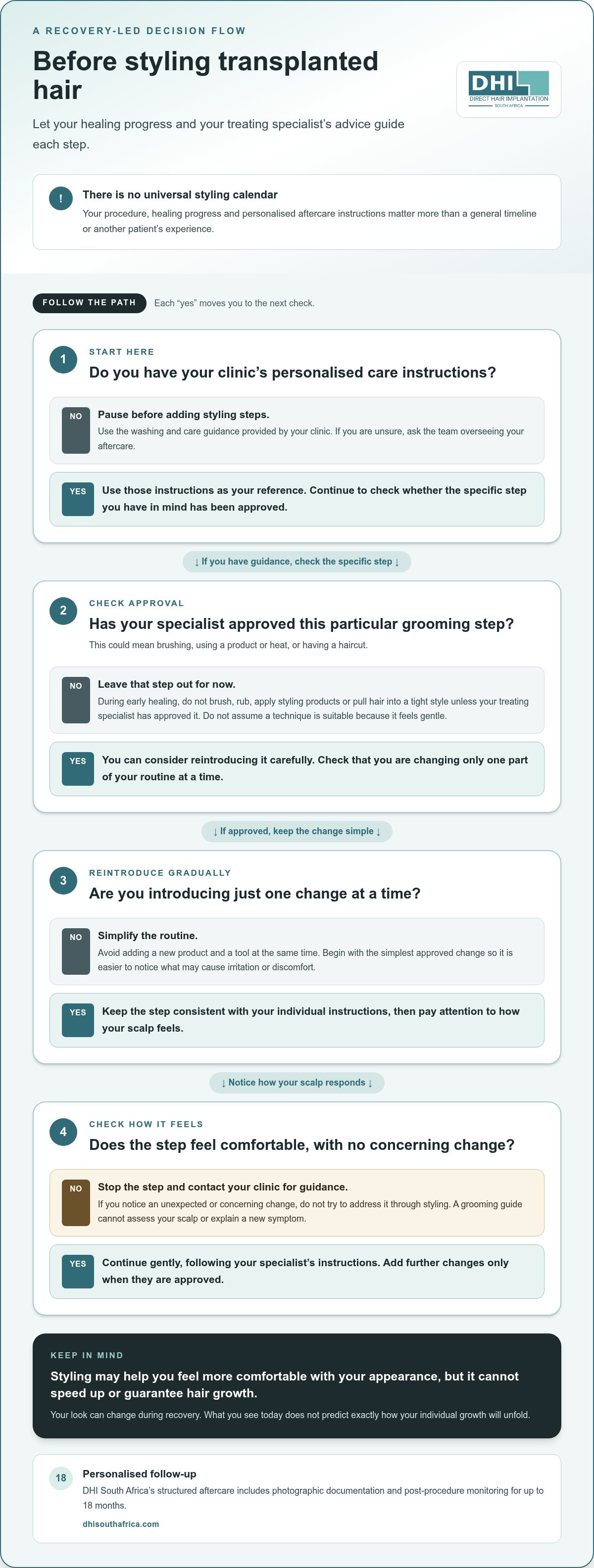
Before reaching for a brush or product, check that your planned activity fits your treating specialist’s latest advice. If it does, keep the routine uncomplicated and gentle. If you’re unsure, pause and ask the clinic overseeing your care rather than relying on a general styling guide.
Review your current guidance. Check your clinic’s instructions and whether they permit the grooming step you have in mind. If the advice has changed since your last check-in, follow the most recent instructions.
Handle your hair with care. Avoid forceful movements or pulling hair into a position it won’t naturally hold. If a technique requires repeated contact with the scalp or tension on the hair, leave it until your specialist says it’s appropriate.
Use only approved products. Follow the clinic’s directions on whether a product is suitable and how to apply it. Don’t add several new products at once; a simple routine is easier to adjust if something doesn’t feel right.
Pay attention to comfort. If you feel discomfort while styling, stop rather than trying to finish the look. Contact your treating clinic for advice if discomfort persists or you notice an unexpected change in your scalp.
This sequence is a practical prompt, not a replacement for medical assessment. Your specialist’s advice determines which steps are suitable for your recovery. If a particular style matters to you, describe what it involves, such as brushing close to the scalp or securing the hair firmly, so you can get guidance that relates to the actual technique.
Adapting styling as your hair changes
Your appearance and styling preferences may shift during the restoration journey. A parting or shape that feels comfortable now may not be your preference later, and temporary changes don’t establish what your eventual result will look like. Avoid using styling as a way to judge or predict density; your specialist can put changes into the context of your individual progress.
Give yourself permission to choose manageable styles as your routine evolves. To learn more about the treatment behind your aftercare, DHI’s hair transplant information provides context on the procedure. For personal questions about a styling step, your treating clinic remains the right source of guidance.
Explore DHI hair transplant aftercare support
Personalised aftercare helps you style with confidence
Styling questions often come up as your routine changes: is a particular brush appropriate now, can you use a product near the scalp, or should you wait before trying a familiar style? These are reasonable questions, and they’re best answered in the context of your recovery. Personalised follow-up gives you a place to discuss practical choices with the specialist who understands your procedure and progress.
General styling tips for transplanted hair can help you think through what to ask, but they can’t account for your individual healing. A specialist can explain which grooming steps fit your current aftercare guidance and help you understand whether a change in appearance needs attention. Follow-up connects everyday decisions with your clinical care.
What personalised follow-up can clarify
At a follow-up, describe the styling choice you’re considering rather than asking only whether styling is allowed. For example, explain whether a product would touch the scalp or whether a hairstyle would pull on the hair. Specific questions make it easier to discuss the technique and how it relates to your recovery.
DHI South Africa uses structured nine-angle before-and-after photographic documentation to record progress. These photographs provide a consistent visual record to review with your clinical team, but they don’t promise or guarantee a particular outcome. The team also provides post-procedure monitoring for up to 18 months, giving you opportunities to raise questions as your needs change.
To understand the broader treatment journey, explore the Direct Hair Implantation information. The hair restoration results page offers examples to view. Individual outcomes vary, so examples should inform your understanding, not set a target for your own progress.
When to seek individual advice
Contact your treating clinic if your instructions don’t clearly cover a product, tool or styling technique you want to use. It’s also sensible to seek guidance if you experience discomfort or notice an unexpected change in your scalp. Don’t try to resolve a clinical concern by changing your hairstyle or relying on general online advice.
Online guidance can support your understanding, but it can’t examine your scalp or replace an individual clinical assessment. If you’re considering Direct Hair Implantation, a DHI specialist can assess your personal suitability and discuss the care involved. You don’t need to have every styling question worked out in advance; bringing your concerns into a conversation is a practical place to begin.
Make your next styling choice with confidence
Your routine can evolve as your recovery progresses. Rather than aiming to recreate your previous style straight away, let your specialist’s advice guide what feels appropriate now, and revisit your preferences as your hair changes. Thoughtful styling tips for transplanted hair are not about controlling growth; they’re about making considered choices while you heal.
Personalised aftercare can help you bring practical questions into a clinical conversation and understand your progress in context. DHI South Africa’s structured follow-up includes photographic documentation and post-procedure monitoring, supporting an individual approach without promising a particular result. If you’re exploring hair restoration, a DHI specialist can discuss your suitability and the care involved.
Take the process at a pace that feels right for you. With clear guidance, you can make each styling decision with greater reassurance.
Frequently Asked Questions
When can I style my hair after a transplant?
You can resume styling when your treating specialist says it’s appropriate for your recovery. There isn’t a single timeline that suits everyone, so don’t use another patient’s experience to decide when to brush, shape or arrange your hair. If you’re preparing for an event, tell your clinic what style you have in mind. They can advise whether the steps involved fit your current aftercare instructions.
Can I use hair products after a hair transplant?
Use hair products only in line with your clinic’s guidance. Product choice and application can matter, especially if they involve contact with the scalp. Before using a familiar styling product, ask your treating team whether it’s suitable for your current stage of recovery and how to apply it. If you’re introducing something new, avoid combining it with other changes so you can identify what may be causing a reaction.
Is it safe to use a hair dryer on transplanted hair?
A hair dryer may be appropriate at some point, but your treating specialist should advise when and how to use one. The distance from your scalp, the heat and airflow settings, and your technique can all affect how it feels. Don’t rely on a general temperature or waiting period as a guarantee of safety. If your instructions don’t cover drying, ask your clinic before using the dryer.
Can brushing damage transplanted hair?
Brushing needs particular caution while the treated area is healing, as contact or pulling may conflict with your clinic’s instructions. Later, brushing may form part of your routine once your specialist approves it. Ask whether your advice differs for the treated area and other parts of your scalp. If the brush catches, pulls or causes discomfort, stop rather than forcing it through, and check with your clinic.
How should I style transplanted hair while it is growing?
Choose a style that feels manageable and follows your current aftercare guidance. You might prefer a simple parting or a shape that doesn’t need repeated handling, provided your clinic has approved the technique. Hair and appearance can change during the restoration journey, so don’t treat today’s look as a forecast of your final result. These styling tips for transplanted hair are a starting point, not a prediction of individual growth.
What should I do if styling causes discomfort after a transplant?
Stop the styling step that’s causing discomfort and don’t try to push through it. Avoid repeating the same technique until you’ve spoken with the clinic overseeing your care. Explain what you were doing and where you felt discomfort, and mention any unexpected change you’ve noticed. Your treating team can advise whether you need an assessment. General styling guidance can’t determine the cause of a symptom.
Does DHI provide aftercare guidance following a hair transplant?
Yes. DHI South Africa provides structured aftercare, including post-procedure monitoring for up to 18 months and photographic documentation using a nine-angle series. This gives the clinical team a record to review with you during follow-up, but it doesn’t guarantee a particular result. For advice about a styling choice, share the specific product or technique you’re considering so your guidance can relate to your individual recovery.


Comments