%20(1).jpg)
%20(1).jpg)
Fixing a Receding Hairline: A Practical Guide to Your Options

The best first step in fixing a receding hairline may not be treatment. A change can feel unsettling, especially when you’re unsure whether it reflects temporary shedding or an ongoing pattern of hair loss. The right approach depends on what may be causing it, how it is changing and what you hope to achieve.
A useful assessment looks at the pattern and timing of the change, your personal history and your scalp. From there, you can compare observation, non-surgical treatments and hair restoration by what each is intended to do, the commitment involved and its limitations. No single option suits everyone, and realistic expectations matter.
This guide explains how personalised hairline planning fits into Direct Hair Implantation (DHI) and what to discuss with a specialist, from the possible cause of your hair loss to aftercare. The aim is to help you weigh your options calmly and decide on a considered next step, without relying on one-size-fits-all claims or promises of a particular result.
Table of Contents
Fixing a receding hairline starts with understanding the change
Fixing a receding hairline starts with understanding its pattern and likely cause, rather than assuming every change needs treatment. A hairline can alter gradually, and noticing that shift may affect how you feel about your appearance. It’s reasonable to want clarity before deciding what, if anything, to do.
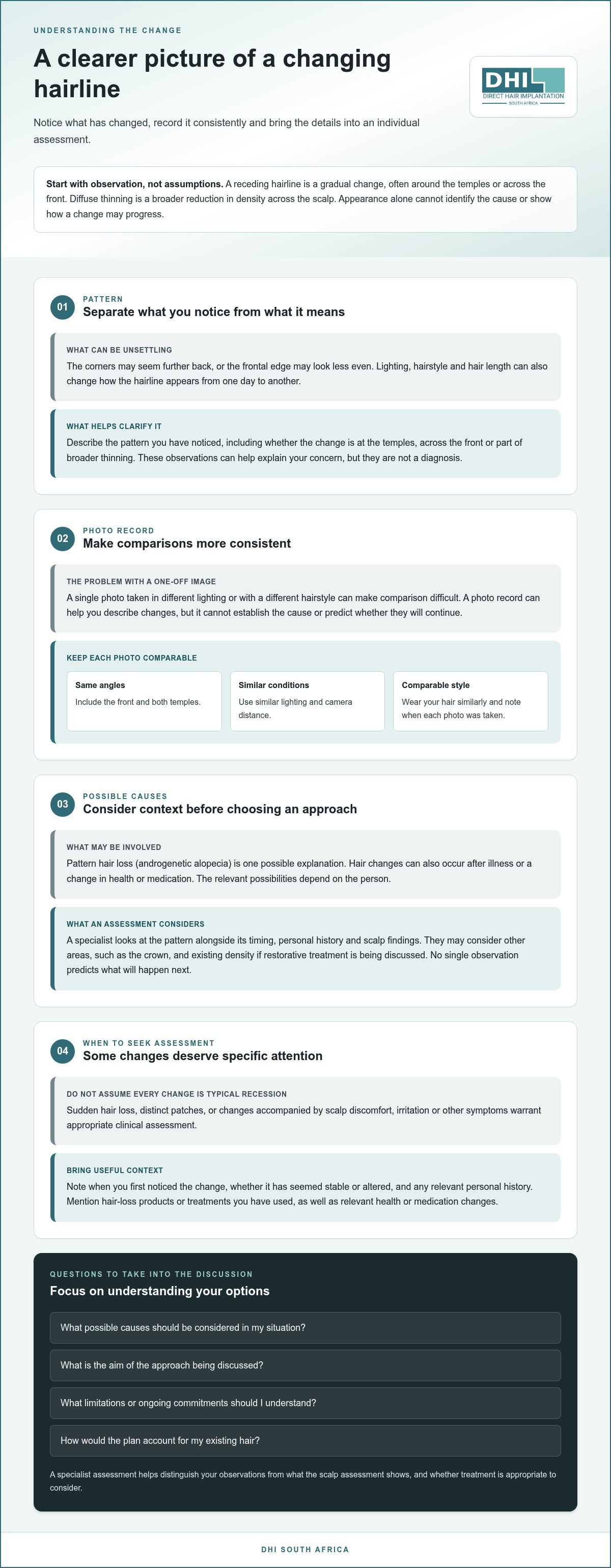
A receding hairline is a gradual change in which the hairline moves back, often around the temples or across the front. Diffuse thinning is a broader reduction in density across the scalp. These patterns can look different, but appearance alone cannot identify the cause or show how the change may progress.
What changes can suggest a receding hairline?
You might notice that the corners of your hairline sit further back than before, or that the frontal edge looks less even. These observations can help you describe what you’ve noticed, but they are not a diagnosis. Lighting, hairstyle and hair length can also affect how your hairline looks from one day to another.
Consistent photographs can make changes easier to track and describe during an assessment. Keep the conditions as similar as possible:
Use the same angles, including the front and both temples.
Choose similar lighting and keep the camera at a similar distance.
Wear your hair in a comparable style, and note when each photograph was taken.
A series of photographs can help you explain your concerns, but it cannot establish what is causing the change or predict whether it will continue. Avoid drawing conclusions from one image taken in different lighting or with a different hairstyle.
Why does a specialist assessment matter?
A specialist considers the pattern alongside its timing, your personal history and scalp findings. A gradual change at the temples may prompt different questions from thinning across the scalp. The aim is to consider these details together, rather than draw a conclusion from one photograph or feature.
One possible cause is pattern hair loss (androgenetic alopecia), a term for hair loss that follows a recognisable pattern and can affect the hairline. It is one possibility, not a conclusion to reach from appearance alone. An assessment can help clarify what needs further discussion before you compare approaches.
A DHI specialist assesses individual suitability before recommending treatment. The discussion can help distinguish your observations from what the scalp assessment shows, and establish whether treatment is appropriate to consider. DHI South Africa’s hair loss assessment information explains the subject in more detail.
Bring your photographs and note when you first noticed the change, whether it has seemed stable or altered, and any relevant personal history. These details give the assessment a useful starting point without obliging you to pursue treatment.
Understand the causes before choosing a hairline treatment
A treatment decision makes more sense once possible causes have been considered. One recognised cause is androgenetic alopecia, commonly called pattern hair loss. In plain English, it is hair loss in which inherited sensitivity can affect how follicles behave over time. It is one possible explanation, not a diagnosis to make from a receding hairline alone.
Hair changes can also occur in different circumstances, including after a period of illness or a change in health or medication. The relevant possibilities depend on the person, so avoid starting treatment based on assumptions or someone else’s experience. The cause matters because different approaches have different aims and may not suit every situation.
How does pattern and progression shape the assessment?
A clinician may look at the hairline alongside other areas, such as the crown, to understand the overall distribution of change. Existing density can also matter if restorative treatment is being discussed. Planning needs to take account of the hair that remains as well as the area of concern.
How long the change has been present and whether it appears to be advancing can inform the conversation, but neither detail alone predicts what will happen next. A specialist should avoid presenting a forecast as certain without an individual medical assessment. This is particularly relevant before considering a procedure, because the plan needs to reflect your current situation and goals.
Sudden hair loss, distinct patches, or changes accompanied by scalp discomfort, irritation or other symptoms warrant appropriate clinical assessment. These features deserve attention rather than being assumed to reflect a typical pattern of recession. Share what you have noticed and any related symptoms so they can be considered in context.
Which questions help clarify the next step?
For a useful discussion, think about what you want to understand, not just which treatment you have heard about. Note when you first became concerned and what has changed since, along with any hair-loss products or treatments you have used. Mention relevant health or medication changes that may help inform the conversation.
What possible causes should be considered in my situation?
What is the aim of the approach being discussed?
What limitations or ongoing commitments should I understand?
How would the plan account for my existing hair?
These questions can help distinguish an option’s intended purpose from claims about what it may achieve. DHI South Africa’s hair-loss treatment options provide broader context on approaches available for discussion. A specialist can explain how they relate to your individual circumstances.
Compare approaches to fixing a receding hairline
Options for a receding hairline serve different purposes. Clinical hair-loss treatments may be discussed as part of managing hair loss, while restorative procedures aim to change the appearance of an area. Observation gives you time to monitor changes without beginning treatment. The right category depends on your situation and what you hope to address.
The appropriate option depends on your assessment and goals; no single approach suits every hairline. Consider whether you want to monitor changes, discuss care for existing hair or explore a procedure. Each option has a different purpose and practical commitment. Ask what it is intended to address, what it cannot do and what ongoing care may involve.
When might non-surgical care be discussed?
DHI South Africa provides GFC, Regenera Activa and PRP as distinct clinical approaches. They are not interchangeable promises of hairline restoration, and their suitability depends on individual circumstances and treatment aims. Reviewing the available hair-loss treatments can help you prepare questions about each approach’s purpose, commitment and limitations for discussion with a specialist.
When might hair transplantation be considered?
A specialist may discuss transplantation if your goal is to restore hair in a particular area and your individual assessment supports considering a procedure. The discussion can include available donor hair, existing density and the hairline you hope to achieve. Recession alone does not mean someone is a suitable candidate, and planning needs to reflect individual circumstances.
Hairline design is a central part of the conversation. Discuss how the proposed shape relates to your preferences and surrounding hair, as well as what practical care may follow. A transplant is a restorative option, not a guarantee against future hair loss or a promise of a particular result. Weigh the procedure and its aftercare against non-surgical care or continued observation before making a decision.
Plan your next steps before treating a receding hairline
A consultation is more useful when you know what you want clarity on. You do not need to arrive with a treatment decision made. Prepare the background a specialist needs and the questions that will help you understand any proposed plan, including its aims, practical commitment and follow-up.
Gather relevant history. Note treatments or products you’ve tried, how you used them and any health or medication details you consider relevant.
Clarify your priorities. Think about what you hope to change and what a natural-looking hairline means to you.
Attend a personalised assessment. Share your concerns and let the specialist explain how your individual circumstances inform the discussion.
Review the proposed plan. Take time to consider the rationale, limitations, aftercare and follow-up before deciding whether to proceed.
What should you prepare for a consultation?
Bring a concise account of relevant treatment and health history, including what you tried and whether you noticed any changes. Write down questions about suitability, the proposed approach and what follow-up may involve. If specific details about your hairline concern you, describe them clearly so the discussion can address your priorities.
Useful questions include: “What is this plan intended to address?” and “What limitations should I consider?” You can also ask how the proposed approach relates to your existing hair and what aftercare guidance you would receive. Clear answers help you weigh the commitment without feeling rushed into a decision.
Visual placeholder: Annotated hairline-planning diagram showing the frontal hairline, temples, existing hair and areas discussed during planning. Use a generic illustration with no identifiable patient details.
How can you judge whether a plan fits your goals?
A considered plan should explain its rationale, realistic aims and limitations in language you understand. Discuss how the proposed hairline design relates to your existing hair and personal preferences. If a procedure is being considered, ask what aftercare and follow-up it involves, and how the plan accounts for your expectations.
Notice whether your priorities are part of the discussion, rather than focusing only on a technique. DHI South Africa’s hair transplant information offers procedure context to help you prepare relevant questions. Examples or diagrams can support a conversation, but they cannot promise that your outcome will match a particular design or another person’s experience.
Taking time to understand the plan is part of making an informed choice. You can decide to proceed, consider another approach or pause while you weigh the information. A specialist discussion should leave you clearer about what is being proposed and why, without obliging you to commit to treatment.
Discuss your hair restoration goals with a DHI specialist and ask how the proposed approach fits your priorities, existing hair and expectations.
How DHI can help with a receding hairline
DHI South Africa provides Direct Hair Implantation (DHI) for people considering a procedure to address the appearance of a receding hairline. It is not suitable for everyone and cannot guarantee a particular hairline or result. A DHI specialist considers your individual hair-loss pattern and goals before discussing whether this approach is appropriate for you.
What happens when DHI is considered?
The discussion can cover your existing hair, the area you would like to address and the hairline design that feels right for you. If a procedure is considered, planning takes account of your suitability and uses your own follicles. Where density or placement is discussed, the plan focuses on the number and distribution of hairs rather than relying on a generic count.
DHI uses a documented single-step implantation system that allows control over the angle, depth and direction of placement. In practical terms, these are factors used to guide how follicles are implanted in relation to the planned hairline. The technique describes the method, not a promise of a specific appearance. Your specialist can explain how it relates to your assessment and aims.
Choosing a hairline is a considered part of planning. It should be discussed in relation to your existing hair and personal preferences, rather than treated as a standard outline that suits everyone. Ask how the proposed design reflects your goals and what limitations may apply to your individual plan.
What can you expect from personalised follow-up?
The documented patient journey includes aftercare guidance, structured photographic documentation and post-procedure monitoring for up to 18 months. Photographs provide a record that can support review over time; they do not guarantee a particular outcome. Your specialist can explain what follow-up involves and how aftercare guidance applies to your situation.
Examples of patient results can help you understand the range of individual experiences, but they are not predictions of what you will achieve. Differences in hair-loss patterns, existing density, goals and suitability mean another person’s result may not reflect your own. Consider examples as context for discussion, not as a promise.
Before deciding, make sure you understand why DHI is being considered, what the proposed hairline plan involves, what follow-up is documented and what limitations have been discussed. It is reasonable to take time to weigh these points. A careful explanation should leave you clearer about both the procedure and the commitment it involves.
For fixing a receding hairline, DHI is one specialist-led option among approaches that may be discussed after assessment. If you would like to explore the technique, review illustrative patient results and discuss your individual suitability with a DHI South Africa specialist.
Take the next step at your own pace
Deciding what to do about your hairline does not have to happen all at once. A useful next step is a conversation centred on your priorities, concerns and what an individual assessment can establish. That gives you space to explore whether treatment fits your situation, without treating a procedure as the automatic answer.
If you are considering DHI, you can discuss how its documented implantation approach and follow-up process relate to your circumstances, including what they can and cannot tell you about a potential outcome. The aim is clarity, not pressure. Fixing a receding hairline is a personal decision, and the right pace is one that allows you to feel informed and comfortable with your options.
Thoughtful questions can help you move towards a decision that feels right for you. Take the next step by discussing your hairline and treatment goals with DHI South Africa.
Frequently Asked Questions
Can a receding hairline grow back naturally?
Sometimes, depending on what caused the change. Hair that appears thinner after temporary shedding may recover as the underlying trigger settles, but hair loss linked to a progressive pattern may not simply reverse on its own. Avoid relying on oils or supplements as a guaranteed fix. If the change continues, becomes pronounced or worries you, a clinician can assess the pattern and discuss whether observation or treatment makes sense.
Is a receding hairline always a sign of male pattern baldness?
No. Pattern hair loss is one possible explanation, but a change in the hairline does not by itself confirm male pattern baldness. Other causes or forms of hair loss may need consideration, particularly if the change is abrupt, patchy or accompanied by scalp symptoms. Women can also experience pattern hair loss. A clinical assessment can help distinguish possibilities instead of relying on assumptions based on sex or appearance.
Can stress cause a receding hairline?
Stress can be associated with increased shedding, but that does not necessarily mean it has caused a receding hairline. Stress-related shedding may make the scalp look less dense, while a hairline change can have other explanations. If shedding follows a stressful period, note when it began and whether it is widespread or concentrated in one area. A clinician can assess the pattern and consider your wider health history.
At what age can someone consider treatment for a receding hairline?
There is not one age that automatically makes treatment appropriate. A specialist considers your health, the pattern and stability of hair loss, available donor hair if a procedure is being considered, and your expectations. For a younger person whose hairline is still changing, it may be important to discuss how that affects planning rather than focusing only on the current appearance. An individual assessment is more useful than age alone.
Will treating a receding hairline stop future hair loss?
Not necessarily. A treatment aimed at improving the appearance of one area may not prevent hair loss elsewhere, and a hair transplant does not treat the underlying cause of ongoing thinning. What happens depends on the cause and the approach chosen. Ask the clinician which changes a proposed treatment is intended to address, what it will not address and whether continued monitoring or other care may be relevant.
How can I make a hair transplant hairline look natural?
A natural-looking plan considers your facial proportions, age, existing hair and the direction in which hair grows. Rather than asking only for a lower hairline, discuss the shape you prefer and how it will sit alongside surrounding hair. In a DHI plan, the specialist considers placement details such as angle, depth and direction. No design can guarantee a particular appearance, so clear expectations and personalised planning matter.


Comments