%20(1).jpg)
%20(1).jpg)
What Does a Natural Hairline Transplant Look Like?

What if the most natural-looking hairline isn’t the straightest or densest one? If you’re asking, “what does a natural hairline transplant look like”, the answer is usually in the transition: a soft, subtly irregular front edge that blends with the surrounding hair, rather than a sharp line that appears drawn on. It should also be in proportion to your face and suit the direction in which your hair naturally grows. It’s understandable to feel uncertain, especially when before-and-after photographs can be difficult to compare.
This guide explains the visual signs to look for, from the hairline’s shape to the gradual shift from finer hairs at the front to greater fullness behind. You’ll also learn how controlled angle and direction affect the result, why a low or densely packed hairline isn’t automatically the right choice, and how lighting, styling and the stage of growth can affect photographs. DHI’s patented, single-step implantation system allows clinical control over placement angle, depth and direction, while the design itself needs to be considered for you. By the end, you’ll have a practical framework for discussing your facial proportions, hair characteristics and expectations during a personalised clinical assessment.
Table of Contents
What does a natural hairline transplant look like in real life?
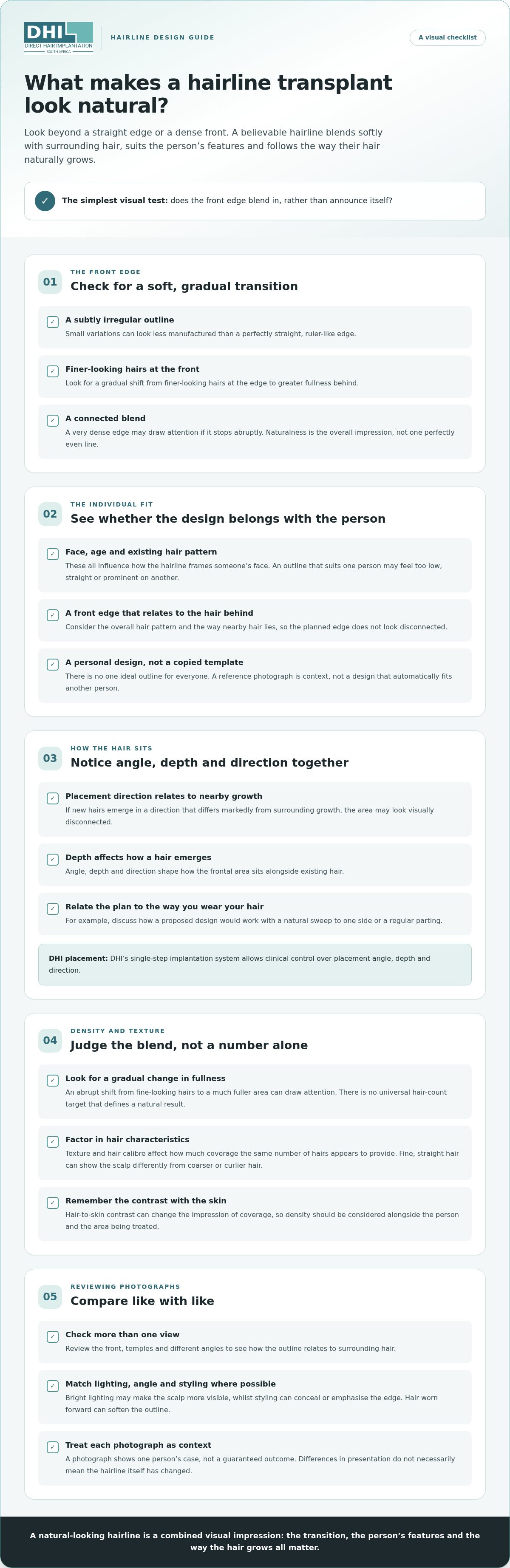
The question “what does a natural hairline transplant look like” is best answered by looking at how the new front edge sits with the person’s facial features and existing hair. A believable result usually has a soft, subtly irregular outline that blends into the scalp, rather than a sharply defined line that looks drawn with a ruler. It should feel like part of the person’s appearance, not a separate feature demanding attention.
Look for a gradual change from finer-looking hairs at the front to greater fullness behind. The edge needn’t be perfectly symmetrical or uniformly dense: small variations can help it look less manufactured. The broader principles behind surgical hair restoration are outlined in this Hair transplantation overview, but each hairline’s appearance depends on individual design and placement.
This video offers a visual illustration of hairline design:
The visible signs of a soft, believable hairline
Rather than judging one detail in isolation, consider the whole frame: the transition at the front, the way the hair sits at the temples, and whether the outline works with the surrounding hair. A very dense edge can look conspicuous if it stops abruptly, while a softer transition may appear more integrated. Naturalness is a combined visual impression, not a single measurement or a perfectly even line.
Styling can conceal or emphasise the edge in photographs, and bright lighting may make the scalp more visible. Hair worn forward can soften the outline. For a fair comparison, check whether the images use similar angles, lighting and styling. Differences in presentation don’t necessarily mean the hairline itself has changed.
Why a hairline should fit the individual
Facial proportions, age and the existing hair pattern all influence how a hairline frames someone’s face. A design that looks balanced on one person may feel too low, straight or prominent on another. There isn’t one ideal outline for all men or women. The aim is a frame that makes sense alongside the person’s features and hair, rather than a copied template.
Hair characteristics and the pattern of thinning matter too. The planned edge needs to relate to the hair behind it, so the transition doesn’t appear disconnected from the rest of the scalp. This is why a hairline discussion should consider your overall appearance, not just a preferred height or reference photograph. DHI’s hair transplant approach can be discussed in a personalised clinical assessment that connects your hairline goals with your facial features and existing hair.
A useful first impression is simple: does the front edge blend, rather than announce itself? Photographs can help you notice this, but styling and lighting affect what they show. Treat them as visual context, not a complete assessment of the design.
Which design details make a transplanted hairline look natural?
A hairline’s appearance depends on how the new hairs relate to existing growth, not simply on how many are placed. Their orientation affects how they emerge and sit when styled, while the transition at the front influences whether the edge looks integrated or separate. These details need to be considered together: an outline that looks balanced on paper may appear different once it meets a person’s own hair pattern.
Direction, angle and the way hair falls
Implantation angle describes the direction a hair appears to emerge from the scalp. If that direction differs markedly from nearby growth, the area may look visually disconnected, particularly when the hair is brushed or parted. A considered design takes account of how surrounding hairs lie, while allowing for natural changes in growth direction across the scalp. The aim is a coherent blend, not an identical orientation for every hair.
Depth also affects how a hair emerges at the surface. Together, depth and direction shape the way the frontal area sits alongside existing hair. For instance, if your hair naturally sweeps to one side, discuss how a proposed design would relate to that pattern. This is a practical point to raise during planning, especially if you regularly wear your hair in a particular style.
Hair restoration techniques and their development are outlined in the American Academy of Dermatology on Hair Transplants. For an individual design, the useful question is how the planned placement will relate to your own growth, rather than whether a technique name alone predicts the appearance.
Density, texture and a gradual front edge
Density is perceived through the transition and surrounding hair, not a number alone. If the front edge shifts abruptly from fine-looking hairs to a much fuller area, that contrast may draw attention. A gradual change can make the transition feel more connected. There is no universal hair-count target that defines a natural result; planning needs to account for the person and the area being treated.
Texture and hair calibre influence how much coverage the same number of hairs appears to provide. Fine, straight hair can show the scalp differently from coarser or curlier hair, and contrast between hair and skin can change the impression further. Existing growth matters too: a design that ignores the way nearby hair lies may look separate when viewed from above or at an angle. Consider these factors together when discussing a hair transplant plan.
Bring specific observations to a clinical discussion: how you part your hair, which direction it usually falls, and whether you prefer a softer or more defined front edge. These details help make the conversation individual, without relying on a fixed density target. A considered plan relates the intended appearance to your characteristics and surrounding hair, rather than treating density as the only measure of success.
Natural versus artificial-looking hairlines: what visual clues matter?
It can be hard to judge a hair transplant from photographs alone, especially when the angle, lighting or hairstyle changes between images. Focus on how the hairline connects with the surrounding hair, rather than treating one feature as proof of success or failure. The table highlights visual cues to notice, not a clinical diagnosis.
These are prompts for observation, not pass-or-fail criteria. A straight edge may attract attention in one image, but that alone doesn’t establish treatment quality. The overall impression depends on how the outline, direction and transition appear together, as well as the person’s features and hair characteristics.
Features that can make a hairline look conspicuous
A sharply drawn-looking front edge or a sudden change in density can stand out because the eye notices abrupt boundaries. The same is true if the hair appears to lie differently from the surrounding growth. But a single detail shouldn’t be treated as evidence of a poor clinical outcome: camera angle, styling and lighting can exaggerate an edge or make the scalp more visible.
Ask yourself what is drawing your attention. Is it the outline, the way the hair falls, or a contrast between the front and the area behind it? Looking at how these details relate gives a more balanced impression than judging a result by density alone.
How to compare natural-looking result photographs
Start by comparing like with like. Check whether the photographs show a similar view, lighting and hairstyle, then look at both the frontal view and angled views. A close-up can reveal detail, but it may not show how the hairline fits the face or temples. Consistency across views offers more useful context than one carefully chosen image.
DHI South Africa’s hair transplant results include a nine-angle photographic series, giving several views of an individual case. As you review examples, consider whether the captions and presentation help you understand the context. A photograph records one person’s appearance; it can’t establish the full clinical quality of their treatment or predict another person’s outcome.
So, what does a natural hairline transplant look like in photographs? Look for a coherent overall impression, not a single perfect line. Use images to guide questions about design and blending, then discuss how those considerations relate to your own features in a personalised clinical assessment.
How can you assess a hairline result without expecting an instant final look?
Before-and-after images are easier to interpret when you know what you’re looking at and when each photograph was taken. A transplant’s appearance can change during follow-up, so photographs from different stages may capture different points in that process. Rather than judging a result as simply “finished” or “unfinished”, use the images to notice what has changed and what remains consistent.
A practical sequence for reviewing before-and-after images
Review the images in the same order each time. This can stop you focusing too quickly on one close-up or detail:
Begin with the overall facial frame. Look at the frontal view and notice how the hairline relates to the face and temples. Consider the general balance, rather than trying to decide whether the line is high or low.
Look at the edge and surrounding area. In closer views, observe the transition at the front and how the hair sits alongside the treated area. Angled views may offer a different perspective from a straight-on photograph.
Compare the views and timing. Check whether the images show different angles and whether the timing of each photograph is stated. Note changes in lighting, styling or camera position that may affect what you can see.
These steps help you describe what stands out and form useful questions. If one photograph seems to show a more defined edge than another, for instance, check whether the styling or angle differs before drawing conclusions. Image captions and dates can help you understand the context.
Why timing and documentation matter
Hair appearance develops over the course of follow-up, so consider a photograph in relation to its timing. A set of images taken at different stages can make changes easier to review than a single snapshot, especially when the views and presentation are consistent. DHI South Africa documents results with a nine-angle photographic series and monitors patients for up to 18 months, providing a record to discuss during follow-up.
Use photographs to notice changes and prepare questions, rather than expecting an immediate final appearance. You might ask how a particular feature is being observed over time or what a difference between two stages means in your own follow-up. A clinical assessment can put those observations into context and connect them to your hairline goals.
You can explore documented hair transplant results for examples of how cases are presented. During a personalised assessment, bring the details you’re curious about and discuss the features that matter most to you. This keeps the conversation focused on your circumstances and appropriate next steps.
For an overview of DHI South Africa’s services, visit DHI South Africa.
How DHI South Africa approaches a natural-looking hairline
A useful hairline discussion starts with your priorities, not a pre-set outline. You may want to restore a frame around your face, keep the result understated, or understand whether a particular shape would suit you. Sharing what concerns you, as well as what you hope to achieve, helps make the assessment specific to your circumstances rather than centred on a reference image alone.
From hairline goals to a considered clinical plan
If you’re learning about the Direct Hair Implantation approach, consider how the procedure fits into a personalised plan rather than viewing a technique name as a guarantee of a particular appearance. Your own hair characteristics and aims remain central to the discussion. A considered assessment can also help distinguish between the look you prefer and what may be realistic for your individual situation.
What to take into a personalised consultation
Bring a few clear examples of hairlines you like, and be ready to describe what appeals to you. It may be the overall frame, the shape at the temples or how softly the front edge is defined. Examples are useful for communicating preferences, not for requesting an exact copy. Jot down questions too, so you can discuss expectations, how progress is recorded and what follow-up involves.
Photographic records and follow-up can provide context for reviewing observed progress over time. Ask how those records will be used in discussions about your case and what they can reasonably show. This can help you understand the process without treating someone else’s photographs as a prediction of your own result. It’s also an opportunity to raise concerns you may not have considered before the assessment.
You don’t need to arrive with a finished design in mind. A thoughtful conversation can clarify your priorities, address uncertainties and help you understand the considerations relevant to your hairline. Take the time you need to reflect on the information and decide what feels right for you.
Explore your options with DHI South Africa through a personalised hairline assessment.
Take the next step with clarity
You may still be asking: what does a natural hairline transplant look like for someone with your features, hair and preferences? There’s no need to settle that question by comparing yourself with a photograph or choosing a design before you understand what may suit you. Use what you’ve learnt to identify what matters most, whether that’s a softer front edge, a particular frame for your face or simply feeling confident about the discussion.
A considered conversation can turn those preferences into clear questions and help you understand the options relevant to your individual circumstances. You can share what you hope to achieve, talk through any concerns and explore the next steps at a pace that feels comfortable. The decision remains yours.
Start with curiosity, ask what matters to you, and take the time you need to make an informed choice.
Frequently Asked Questions
Can a hair transplant create a natural-looking hairline?
Yes, a hair transplant can create a natural-looking hairline, but no particular appearance can be guaranteed. The design and placement need to take account of your features, hair characteristics and existing growth. During an assessment, discuss what you hope the hairline will look like in everyday situations, such as wearing your hair back or parted. That helps make your preferences part of a realistic clinical discussion.
Should a natural hairline be perfectly straight?
No. A perfectly straight hairline isn’t a universal standard for a natural appearance. Some people may have a relatively even outline, while others have more variation at the front or temples. The key is whether the design looks appropriate for the individual, rather than whether it follows a rule. If you have a reference image, explain which part appeals to you instead of treating its exact outline as a template.
Does hair texture affect how natural a transplanted hairline looks?
Yes. Texture can change how much visual coverage hair seems to provide and how it sits when styled. For example, wavy hair may fall differently from straight hair, so the same outline can create a different impression. Colour contrast between hair and scalp can also affect how visible the front edge appears in certain lighting. Include these details in a personalised discussion, rather than judging a design from hair count alone.
How long does it take for a transplanted hairline to look natural?
There isn’t one timeline that applies to everyone. Transplanted hairs commonly shed during the first few weeks, with new growth often beginning around three to four months; a mature result may take 12 to 18 months to become visible. These are general timeframes, not a prediction for an individual. Changes during the process can feel unsettling, so discuss what you’re seeing with your clinical team and consider it in the context of follow-up.
What happens if my natural hair continues to thin after a transplant?
A transplant doesn’t prevent non-transplanted hair from changing over time. If you notice thinning around or behind the treated area, arrange a clinical review rather than assuming the transplanted hair has failed. A specialist can assess the pattern and discuss suitable next steps in light of your scalp and treatment history. This is one reason to raise future hair-loss concerns during planning, not only after changes become noticeable.
Can I tell whether a hairline transplant is natural from one photograph?
Not reliably. A single image can show an angle or lighting condition that makes the hairline appear softer, sharper or denser than it does in other views. Cropping and styling can also leave out useful context. Treat a photograph as one observation, not proof of clinical quality or a forecast for your own result. If you’re reviewing an example, note what the image does and doesn’t allow you to see.


Comments