%20(1).jpg)
%20(1).jpg)
Crown Thinning for Men: Clinical Restoration Guide 2026
- Dhesan Moodley

- 3 hours ago
- 12 min read
The moment you start using a second mirror to check the back of your head is the moment the paranoia truly sets in. It's a frustrating reality that the area you can see the least is often the one that causes the most anxiety, specifically the fear of developing a visible "monk" patch. Finding genuine crown thinning solutions for men is often made harder by a sea of marketing hype that prioritises sales over science. Since approximately 95 per cent of all male hair loss is caused by androgenetic alopecia, you deserve a clinical approach that respects the unique whorl and direction of your natural hair growth.
We recognise that restoring the crown is a sophisticated task that demands both medical precision and an artistic eye. This guide provides a clear pathway through the most effective medical and surgical treatments available in South Africa for 2026, focusing on permanent, natural results. You'll discover how we use detailed diagnostic reports to create a bespoke plan, ensuring we place every hair with the exact angle needed for seamless density. We're here to help you move from uncertainty to a structured, long-term strategy that protects your hair and restores your self-assurance.
Table of Contents
Understanding Crown Thinning: The "Danger Zone" of Male Hair Loss
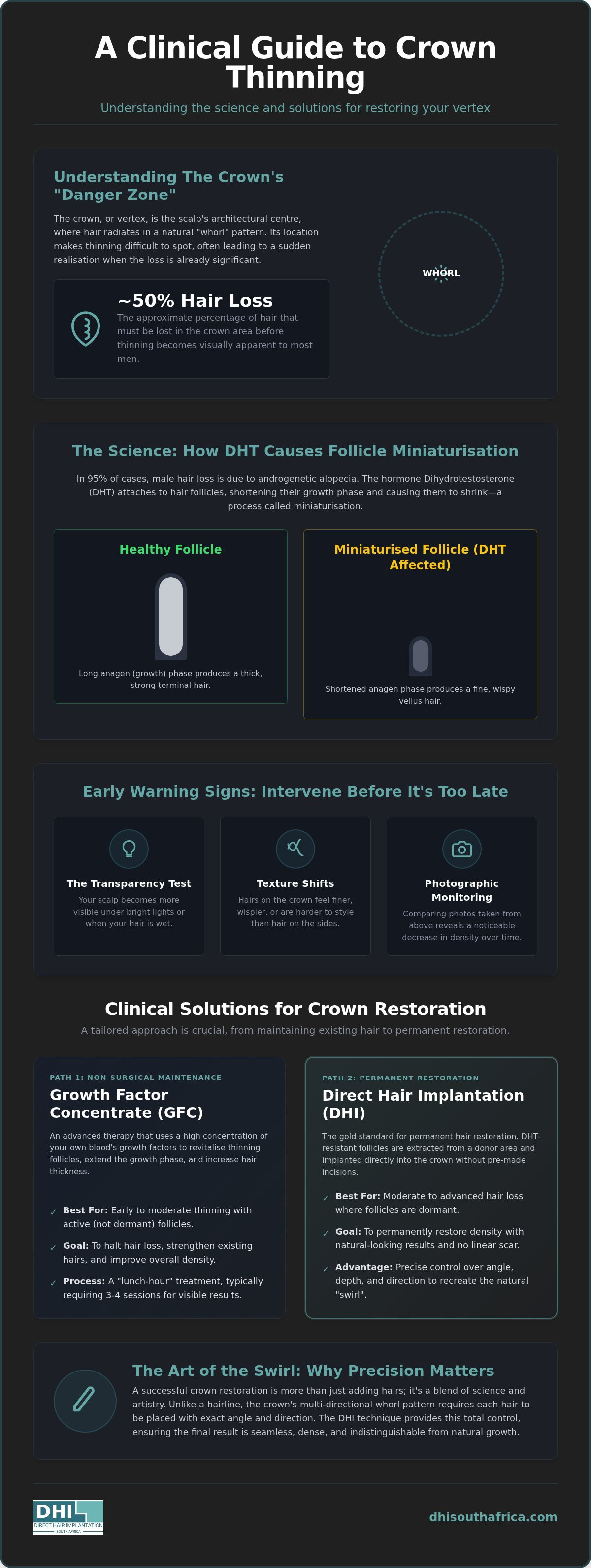
The crown, or vertex, is more than just the back of your head; it's the scalp's architectural centre where hair growth radiates in a natural whorl or swirl pattern. Unlike a receding hairline that greets you in the mirror every morning, thinning here often remains hidden until it's well advanced. It's a clinical reality that most men only identify vertex loss once approximately 50 per cent of the hairs in that specific area have already vanished. This "invisible" progression often leads to a sudden sense of paranoia when a photograph or a dressing room mirror reveals the scalp beneath. Finding effective crown thinning solutions for men starts with understanding that this isn't just "getting older," it's a biological process driven by genetics.
Research confirms that approximately 95 per cent of all male hair loss is caused by androgenetic alopecia. At the crown, this typically manifests as a circular thinning area that expands outward over time. Because you cannot easily monitor this area yourself, the emotional impact can feel more jarring than other forms of loss. The transition from a full head of hair to a visible "monk's patch" creates a significant blow to self-assurance, but identifying the underlying science is the first step toward reclaiming your density.
The Science of Follicle Miniaturisation
When exploring crown thinning solutions for men, we must look at the role of dihydrotestosterone (DHT). In men with a genetic predisposition, DHT attaches to receptors in the hair follicles at the vertex, gradually stifling their ability to grow. This process significantly shortens the anagen phase, which is the active growth period of the hair cycle. As this phase shrinks, the hair doesn't have enough time to reach its full length or thickness. Miniaturisation is the process where terminal hairs transform into vellus hairs due to hormonal sensitivity. Eventually, these follicles may stop producing visible hair altogether, leaving the scalp exposed.
Spotting the Early Signs of Vertex Loss
Early intervention is the most effective way to preserve your natural density before the follicles become dormant. You don't have to wait for a bald spot to appear before taking action. Look for these subtle indicators during your daily routine:
The transparency test: If you notice your scalp is clearly visible under bright bathroom lights or when your hair is wet, the density has already begun to drop.
Texture shifts: Hairs at the vertex might feel finer, wispy, or more difficult to style compared to the hair on the sides of your head.
Photographic monitoring: We recommend a 9-angle perspective for tracking, which involves taking photos from the top, back, and sides to catch changes that a standard mirror might miss.
Identifying these changes early allows us to implement a Total Medical Hair Restoration report. This diagnostic tool gives you a clear, data-driven map for your recovery rather than relying on guesswork.
Non-Surgical Crown Thinning Solutions for Men
If you've noticed early signs of vertex loss, you aren't necessarily destined for a transplant tomorrow. For many, the most effective crown thinning solutions for men involve clinical maintenance designed to "freeze" the loss and revitalise existing follicles. We've moved far beyond the generic, off-the-shelf serums found in pharmacies. Today, the gold standard involves autologous therapies; treatments that use your body's own biological material to stimulate growth.
The primary goal here is maintenance. You're keeping the hairs you have whilst strengthening those that are starting to thin. This 360-degree approach often combines clinical procedures with high-grade nutraceuticals to ensure your scalp has the nutrients it needs to thrive. Before starting any regimen, a professional Total Medical Hair Restoration report is essential to determine if your follicles are still active or if they've entered a dormant phase.
Growth Factor Concentrate (GFC) Therapy
GFC represents a significant clinical evolution from traditional PRP. Whilst both use your blood, GFC employs a sophisticated process to extract a much higher concentration of growth factors. These are the biological signals that tell your follicles to stay in the anagen phase. Most patients see a visible improvement in hair thickness and scalp coverage after just 3 to 4 sessions. It's available across our South African clinics as a "lunch-hour" treatment, making it a favourite for busy professionals.
Regenera Activa and PRP Options
For those looking for advanced cellular support, Regenera Activa uses progenitor cells to stimulate self-regeneration. It's a single-session therapy that works at a microscopic level to repair the scalp environment. PRP remains a foundational tool for boosting circulation and delivering oxygen to the vertex. These crown thinning solutions for men are often used in tandem with surgical restoration. This ensures the highest survival rate for transplanted hairs, creating a robust biological foundation for long-term density.
Surgical Restoration: The Permanent Solution for the Crown
When non-surgical crown thinning solutions for men have reached their limit, surgical restoration offers a permanent path forward. This transition marks the move from preservation to active replacement. We utilise healthy, DHT-resistant hairs from the back and sides of your scalp, where follicles are genetically programmed to grow for a lifetime. The crown is notoriously demanding; because hair grows in a circular whorl, it often requires a significantly higher volume of hairs than a receding hairline to achieve the same visual density. You can see the transformative power of this precision by exploring our hair transplant results, which showcase natural density restored to the vertex.
Direct Hair Implantation (DHI) vs. Traditional FUE
Traditional restoration methods often struggle with the crown because the follicles are exceptionally fragile. Our patented Direct Hair Implantation (DHI) technique addresses this by using a specialised DHI Implanter to place hairs directly into the scalp. There is no need for pre-made incisions or "slits," which reduces trauma to the skin and the hair itself. This "no-touch" approach ensures the hairs spend minimal time outside the body, maintaining their vitality. It's the reason we consistently achieve a survival rate of over 90 per cent, whereas the industry average for traditional FUE often hovers between 50 and 60 per cent. By ensuring more hairs survive the move, we provide a more predictable and robust outcome for every patient.
The "No Scar, No Stitches" Advantage
We understand that many men hesitate to seek help because they fear visible scarring or a long, painful recovery process. Modern clinical standards have thankfully made the invasive "linear scar" associated with older FUT strip surgery a thing of the past. DHI is a minimally invasive procedure that requires no stitches and leaves no detectable scars, even if you prefer to keep your hair short. This level of safety and artistry allows our patients to return to their normal South African lifestyle almost immediately. Often referred to as a "lunch-hour" transplant, the procedure is designed for efficiency and patient comfort. It's a discreet way to restore your crown, ensuring the only thing your peers notice is your renewed sense of self-assurance.
The Art of the Swirl: Why Precision Matters at the Crown
Restoring the vertex is a task that separates basic technical skill from true medical artistry. Whilst a hairline follows a relatively predictable forward-facing path, the crown is defined by a complex, multi-directional "whorl" pattern. Every hair must be placed at a specific angle and depth to mimic this natural spiral. If the placement is even a few degrees off, the results look unnatural and tufted. This is why precision is the most critical factor when evaluating crown thinning solutions for men.
The patented DHI Implanter is our primary tool for achieving this level of detail. It allows our certified doctors to control the angle, direction, and depth of every single hair with absolute certainty. We don't just aim for density; we aim for coverage that works with your natural growth. By orienting the hairs in a strategic spiral, we create the illusion of a much fuller crown using a conservative number of donor hairs. This approach ensures maximum visual impact without over-harvesting from the back of your head.
Angle and Direction Control
Our certified DHI doctors map your unique scalp architecture before a single hair is moved. They ensure each new hair follows the specific exit angle of the surrounding area, which varies significantly across the vertex. We avoid the "doll-hair" look by meticulously varying the placement of individual hairs rather than using uniform rows. This artistic vision ensures your restoration looks seamless even under harsh sunlight or close inspection. It's about recreating the organic flow of your hair, not just filling a gap.
Future-Proofing Your Crown
A successful restoration isn't just about how you look today; it's about how your hair will age over the next 20 years. We take a long-term view of your donor area, which is a finite resource. It's often unwise to use all your available donor hairs in a single session if your hair loss is likely to progress elsewhere. When designing crown thinning solutions for men, we focus on "strategic density." This means placing hairs where they provide the most visual impact whilst preserving enough donor capacity for future needs. A successful transplant considers how your hair will age over the next 20 years to maintain a natural balance.
Taking the Next Step: Your Restoration Roadmap
Restoring your hair isn't a single event; it's a meticulously planned medical journey. The most effective crown thinning solutions for men don't begin at a pharmacy counter but with a comprehensive clinical diagnosis. Jumping into treatments without a clear understanding of your scalp's biology often leads to wasted time and disappointing results. We advocate for a "prevention first" mindset, where we protect your existing hairs whilst building a permanent, high-density solution for the areas that need it most. This structured approach ensures that every decision we make is backed by medical science rather than marketing promises.
Your roadmap starts with a Total Medical Hair Restoration report. This is a medical-grade diagnostic tool that moves beyond surface-level observation to give us a data-driven view of your follicle health. By understanding the specific rate of loss and the capacity of your donor area, we can build a personalised plan that accounts for your lifestyle and aesthetic goals. It's about creating a strategy that provides immediate density whilst ensuring you have enough donor hair to maintain a natural look as you age.
The Diagnostic Phase
During your first clinical consultation, we perform a digital trichoscopy. This is a high-magnification analysis of your scalp and hair health that allows us to identify the specific cause of your loss. We look for signs of miniaturisation and assess the density of your donor area to ensure you're a suitable candidate for DHI or non-surgical therapies. This phase is essential for choosing the right crown thinning solutions for men, as it eliminates the guesswork often found in generic treatments. You can begin this process today by visiting our contact page for a digital scalp analysis.
Life After Restoration
The commitment to your results doesn't end when you leave the clinic. We implement an 18-month monitoring protocol to track the growth of your new hairs and ensure your scalp remains healthy. This long-term partnership allows us to adjust your maintenance routine as your hair matures. Maintaining your investment involves using the right medical-grade hair care products and following a structured plan to prevent future thinning in non-transplanted areas. This ensures your results remain seamless and dense for years to come.
Ultimately, the goal is more than just a fuller crown. It's about the return of self-assurance and the end of the paranoia that often accompanies vertex loss. When you have a long-term plan in place, you can stop worrying about the future of your hair and start enjoying the results of world-class medical science. A fuller crown changes how you see yourself in the mirror, allowing you to move through life with renewed confidence.
Reclaiming Your Natural Density and Confidence
Restoring a thinning crown is a journey that transforms your self-perception as much as your appearance. Successful results rely on a clinical approach that respects the unique architectural whorl of your scalp. By combining detailed diagnostics with world-class expertise, you can move from the anxiety of vertex loss to the certainty of a permanent, natural result. Our certified medical experts specialise in crown thinning solutions for men that utilise the patented DHI technique, ensuring a hair survival rate of over 90 per cent.
With a 99 per cent customer satisfaction rate, we've helped thousands of men across South Africa navigate their restoration with absolute trust. You don't have to settle for the "monk" look or temporary fixes that fail to deliver. It's time to take control of your hair's future with a plan designed for longevity and aesthetic excellence.
We're ready to guide you through every step of your transformation with the care and precision you deserve.
Frequently Asked Questions
Is crown thinning reversible without surgery?
Crown thinning is often reversible or manageable without surgery if you intervene whilst the follicles are still active. Clinical crown thinning solutions for men, such as GFC therapy or Regenera Activa, focus on revitalising miniaturised follicles to restore thickness and halt further loss. However, once a follicle has completely ceased production and the scalp is smooth, surgical restoration is the only way to achieve permanent density in that specific area.
How many hairs are usually needed for a crown transplant?
Most crown restorations require between 2,000 and 4,000 hairs to achieve a natural and dense appearance. Because the vertex features a multi-directional whorl pattern, it often demands a higher volume of hairs than a similar-sized area on the hairline to ensure full coverage. During your consultation, we use digital trichoscopy to calculate the exact number of hairs needed to create a seamless transition whilst preserving your donor area.
Does a crown hair transplant look natural as it grows?
A crown transplant looks entirely natural provided the surgeon meticulously mimics your original "spiral" growth pattern. Using the DHI Implanter, our doctors control the depth, angle, and direction of every hair to ensure it blends perfectly with your natural whorl. This precision prevents a tufted look and ensures that as your hair grows, it follows the organic flow of your scalp architecture, even under close inspection.
How long does it take to see results from GFC therapy?
You will typically begin to notice visible improvements in hair thickness and scalp health after three to four sessions of GFC therapy. Whilst the initial biological response begins immediately, the most significant changes in density usually manifest between six and nine months. This timeline aligns with the natural hair growth cycle, as your follicles transition back into the anagen phase to produce stronger and more resilient hairs.
Will I have a scar on the back of my head after a DHI procedure?
You won't have any visible linear scarring or stitches on the back of your head following a DHI procedure. Unlike older FUT methods that leave a permanent strip scar, the DHI technique is minimally invasive and leaves no detectable marks. This allows you to keep your hair as short as you like without worrying about revealing any evidence of your clinical restoration, ensuring a discreet recovery process.
Can I use Minoxidil alongside DHI treatments?
You can certainly use Minoxidil alongside DHI treatments, and it's often recommended as part of a long-term maintenance strategy. Whilst DHI provides a permanent solution for lost density, topical treatments help preserve the non-transplanted hairs surrounding the crown. We typically advise a short break from topical applications immediately after your procedure to allow the scalp to heal, but it remains a valuable tool in your wider restoration roadmap.
What is the best age for a man to seek crown thinning solutions?
There is no single "best" age, but seeking crown thinning solutions for men is most effective at the first sign of visible loss, typically from your mid-twenties onwards. Early intervention allows us to use non-surgical therapies to maintain your natural density before a transplant becomes necessary. We always consider your age and future loss patterns to ensure your restoration plan remains aesthetically balanced as you mature over the coming decades.
Why is the crown often more difficult to treat than the hairline?
The crown is more complex to treat because of its circular growth pattern and the tendency for thinning to expand in all directions. Achieving natural coverage requires a sophisticated understanding of the vertex "swirl," where hairs exit the scalp at varying angles. Additionally, the crown often requires more hairs to create a sense of fullness compared to the hairline, as the hair naturally parts and lies flat in this area.


Comments