%20(1).jpg)
%20(1).jpg)
Regenera Activa Hair Therapy: A Clinical Guide to Follicle Regeneration
- Dhesan Moodley

- 2 days ago
- 11 min read
What if the most potent solution for your thinning hair wasn't found in a chemist's bottle, but was already residing within your own scalp? We understand the quiet frustration of watching your hairline recede despite trying every supplement and tonic available in South Africa. It's exhausting to feel that sense of helplessness, especially when you're wary of invasive surgeries or confused by the conflicting claims of various 'stem cell' treatments. You deserve a solution that is both scientifically grounded and respectful of your body's natural biology, which is why regenera activa hair therapy has become such a vital tool in modern restoration.
By utilising advanced autologous micro-grafting technology, this treatment harnesses your own regenerative cells to reverse follicle miniaturisation and restore natural hair density. In this clinical guide, we'll explore how this single-session, no-downtime procedure provides a sophisticated alternative to traditional methods. You'll discover exactly how we transform healthy tissue into a biological catalyst for growth, helping you regain not just your hairs, but your quiet confidence.
Table of Contents
What is Regenera Activa Hair Therapy and How Does it Work?
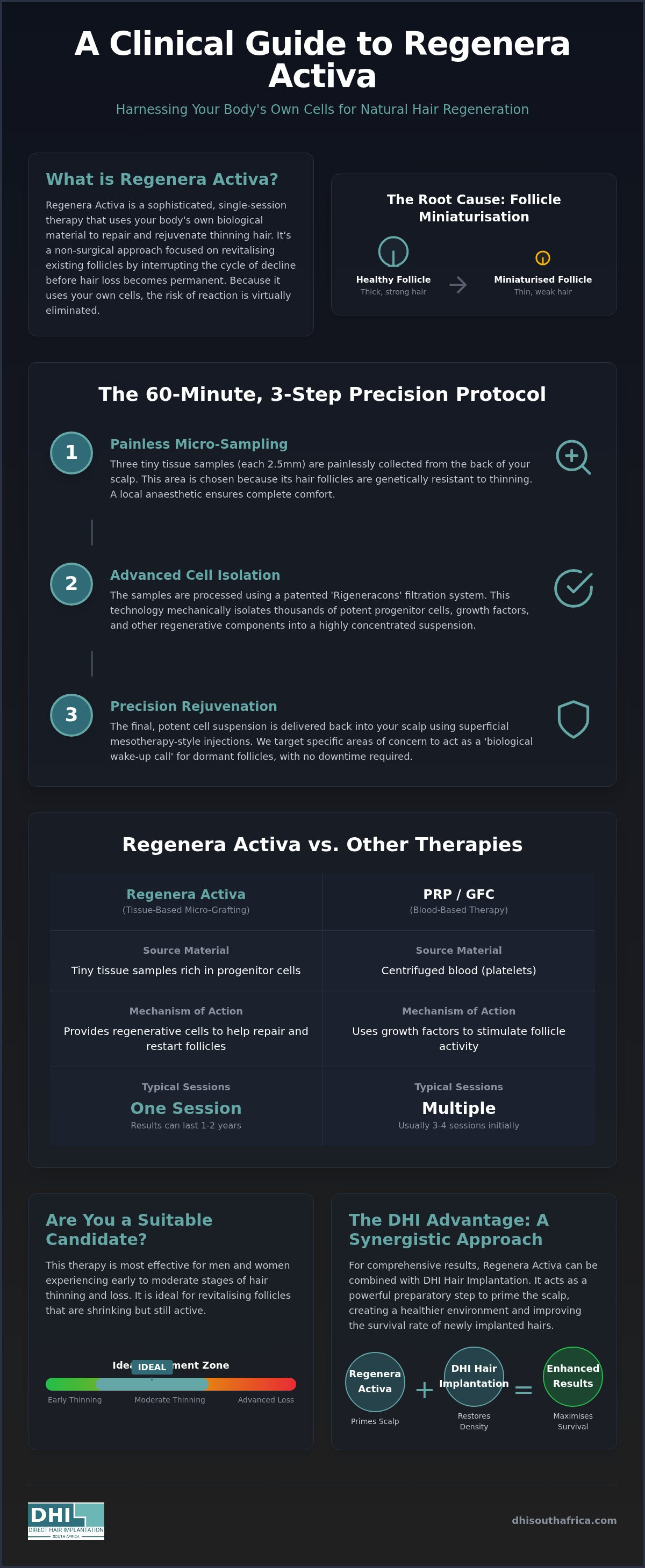
Regenera activa hair therapy is a sophisticated, non-surgical treatment that falls under the umbrella of autologous micro-grafting. To put it simply, it uses your body's own biological material to repair and rejuvenate areas where hair is thinning. Unlike surgical transplants that move hairs from one place to another, this therapy focuses on revitalising the follicles you already have. It's a targeted approach designed to interrupt the cycle of decline before it becomes permanent.
At the heart of most thinning concerns is a process called miniaturisation. This occurs when hair follicles gradually shrink under the influence of hormones, specifically dihydrotestosterone (DHT). As the follicle constricts, the hairs it produces become progressively thinner, shorter, and less pigmented. Eventually, the follicle may stop producing visible hair altogether. Understanding this process is vital for the effective Management of hair loss, as it identifies the exact moment when regenerative intervention can still make a difference.
The Biological 'Wake-up Call' for Follicles
This therapy works by introducing a concentrated suspension of progenitor cells directly into the scalp. These are precursor cells that possess the unique ability to differentiate into the specific tissues needed for follicle health. When injected, they act as a biological 'wake-up call,' encouraging follicles to transition from a dormant state back into the anagen, or growth, phase. This autologous micro-grafting technique ensures that the scalp receives a multitargeted boost, addressing the root causes of androgenetic alopecia without the need for synthetic drugs.
Why 'Natural' Matters in Hair Restoration
Because we use your own biological material, the risk of allergic reaction or rejection is virtually non-existent. This 'natural' approach is often preferred by those who want to avoid the side effects sometimes associated with long-term pharmaceutical use. However, the first step is always ensuring you're a suitable candidate through a professional hair loss diagnosis. By using your own growth factors and progenitor cells, we're not just masking the symptoms; we're leveraging the body's innate ability to heal itself.
The Regenera Activa Procedure: A 3-Step Precision Protocol
One of the biggest hurdles for our patients is the fear of time. Traditional surgical options often require significant recovery, but regenera activa hair therapy is specifically designed for the modern South African professional. It's often called a 'lunch-hour' treatment because the entire session is completed within 60 minutes. Performed by our certified medical experts, the procedure prioritises your comfort, ensuring you feel reassured and relaxed throughout the three-step precision protocol.
Step 1: The Micro-Sampling Process
To begin, your doctor extracts three tiny tissue samples, each only 2.5mm in diameter, from the back of your scalp. We select this specific area because the follicles here are genetically resistant to the thinning effects of DHT. To ensure a completely painless experience, we apply a local anaesthetic before the micro-sampling begins. These small extraction points heal quickly and are virtually invisible, even with shorter hair styles.
Step 2: Advanced Mechanical Disaggregation
Once collected, the samples are placed into a specialised device for mechanical disaggregation. This is where the science truly shines. Using a patented process called 'Rigeneracons' filtration, the device isolates the vital regenerative cells from the solid tissue. This creates a highly concentrated suspension of progenitor cells, growth factors, and extracellular matrix proteins. This technology is backed by extensive research, as detailed in A Decade of Autologous Micrografting Technology in Hair Restoration, which highlights how this specific concentration levels the playing field for those struggling with early-stage thinning. This advanced filtration results in a highly concentrated suspension that contains thousands of viable progenitor cells ready to revitalise your scalp.
Step 3: Precision Re-Injection
In the final stage, your doctor uses mesotherapy-style injections to deliver the cell suspension back into the scalp. We focus on your specific areas of concern, such as a thinning crown or a receding hairline, to ensure the most impact. Because the injections are superficial, there is no significant downtime. You can return to your office or daily routine immediately after leaving the clinic. If you're curious about how this fits into your schedule, you can always reach out to our team for a quick chat about the process.
Regenera Activa vs PRP and GFC: Which Therapy is Right for You?
Choosing the right path for restoration often feels like a daunting task when you're faced with a list of medical acronyms. At our clinics in South Africa, we guide patients through what we call the 'Regenerative Spectrum.' This spectrum ranges from foundational blood-based treatments to more advanced tissue-based interventions. Whilst all these options aim to revitalise your scalp, understanding the difference in their biological 'fuel' is the key to making an informed decision. Regenera activa hair therapy sits at the high-potency end of this spectrum because it introduces actual cellular machinery into the thinning areas.
The fundamental distinction lies in the source material. PRP and GFC rely on platelets extracted from your blood. In contrast, Regenera Activa utilises solid follicular tissue. This is a significant shift in approach. Tissue-derived progenitor cells provide a much more durable and robust signal for follicle repair than blood-derived growth factors alone. Think of it as the difference between a temporary energy boost and a long-term infrastructure upgrade for your scalp.
Regenera Activa vs PRP (Platelet-Rich Plasma)
PRP is a well-established foundational treatment that many patients explore first. It involves drawing a small amount of your blood, spinning it in a centrifuge to isolate the platelets, and re-injecting that plasma into the scalp. It's an excellent maintenance tool, but it usually requires a series of monthly sessions to sustain results. This can be a significant time commitment for a busy professional.
Regenera Activa offers a more streamlined 'one-and-done' alternative. Because the progenitor cells are harvested from your own scalp tissue, they are already 'programmed' for hair health. A Clinical study on Regenera Activa efficacy suggests that this tissue-based approach can yield more significant density improvements in cases where blood-based therapies might plateau. For most of our patients, a single annual session is sufficient to maintain their results, making it far more convenient than a monthly PRP schedule.
Regenera Activa vs GFC (Growth Factor Concentrate)
GFC is a more refined version of PRP. In this process, growth factors are intentionally released from the platelets in a laboratory setting before the injection, ensuring a highly concentrated dose. It's a powerful option for those in the very early stages of thinning. However, when comparing PRP vs GFC to a stem cell approach, GFC still lacks the regenerative cells found in solid tissue.
We often recommend GFC as a maintenance booster between annual Regenera sessions rather than a replacement for them. We view your restoration as a tailored, long-term journey. Exploring Advanced Hair Loss Solutions allows us to combine these technologies into a comprehensive plan that keeps your hair at its peak density throughout the year.
Patient Selection: Are You a Candidate for Regenera Activa?
"Will this actually work for my specific stage of hair loss?" is the most common question we hear during our consultations. It's a valid concern; nobody wants to invest time in a treatment that isn't tailored to their needs. The success of regenera activa hair therapy depends entirely on the biological 'soil' of your scalp. It's specifically designed for those in the early to moderate stages of thinning, typically categorised as Norwood 2-4 for men or Ludwig I-II for women.
The procedure requires the presence of existing, albeit dormant, follicles to be effective. If your scalp has become completely smooth and the follicles have been absent for years, the regenerative cells won't have a structure to revitalise. Gender also plays a role in how we map out the treatment journey. Men often focus on the receding hairline or crown, whilst women typically see a diffuse thinning that requires a broader application across the top of the scalp to restore lost volume.
The Importance of Early Intervention
Acting quickly is the best way to ensure a high hair count in the future. When you catch miniaturisation early, you're essentially saving follicles before they reach a 'point of no return.' Once a follicle has completely ceased production and the skin has closed over, the only way to restore hair is through surgical intervention. You can view natural hair transplant results to understand the difference between regenerating your existing hairs and implanting new ones in areas of total loss.
Contraindications and Safety
We take a cautious, medical-first approach to every session. Whilst the autologous method is exceptionally safe for a wide variety of patient profiles, it isn't universal. Conditions like active scalp infections or specific types of scarring alopecia may mean that regenera activa hair therapy isn't the right choice for you at this time. At DHI South Africa, we perform 18 mandatory clinic safety checks to ensure every procedure meets our world-class standards. This methodical process guarantees that we only move forward when it's entirely safe and clinically appropriate for your scalp health.
The DHI Advantage: Combining Regenera Activa with Hair Implantation
While many view hair restoration as a choice between medical therapy and surgery, the most effective results often come from a synergy of both. We frequently recommend a 'Super-charged' approach where we use regenera activa hair therapy to prime the scalp before a procedure. This preparatory step creates a fertile, nutrient-rich environment that can significantly reduce post-surgical inflammation and accelerate the initial healing phase. By addressing the health of the scalp tissue alongside the implantation, we establish a stronger foundation for long-term growth.
This combination is widely considered the 'Gold Standard' for comprehensive hair restoration in South Africa. When we perform a procedure involving the placement of 4,000 hairs or more, the vitality of the recipient area is paramount. Regenera Activa provides the biological support needed to ensure that these hairs transition smoothly into their new environment, maximising the visual density achieved. It's a holistic method that ensures every aspect of your scalp health is managed with clinical precision.
Enhancing Graft Survival with Progenitor Cells
The science of survival is simple: the more receptive the scalp, the better the hairs will thrive. By introducing progenitor cells, we improve the vascularisation of the area, ensuring that each implanted follicle has immediate access to the blood supply it needs. This protocol works seamlessly with our Direct Hair Implantation technique, which uses patented, single-use instruments to ensure precision and minimal tissue trauma. This dual-layered strategy ensures that the newly placed hairs aren't just surviving; they're actively flourishing from day one.
Your Path to Restoration: The Next Steps
Every journey begins with clarity. We invite you to book a professional consultation for a digital scalp analysis, which allows us to see exactly what is happening beneath the surface of your skin. This data-driven approach results in a personalised Total Medical Hair Restoration report, giving you a clear roadmap for your specific needs. It's important to remember that you don't have to face the anxiety of thinning hair alone. Medical science has provided us with remarkable tools to restore your density, and we're here to guide you through every step of that transformation with the care and expertise you deserve.
Reclaiming Your Confidence Through Regenerative Science
We've explored how regenera activa hair therapy transforms your own biological material into a potent catalyst for follicle growth. This single-session protocol offers a sophisticated, tissue-based alternative to repetitive blood-derived treatments, focusing on the precision of progenitor cells to halt miniaturisation. Whether used as a standalone solution for early thinning or to prime the scalp for a transplant, this technology represents a significant leap in regenerative medicine.
At DHI South Africa, we prioritise your safety and results above all else. Every procedure is performed exclusively by DHI-certified medical doctors, a standard that has helped us maintain an IMRB-accredited 99% customer satisfaction rate. When this therapy is used to enhance our implantation techniques, we consistently achieve graft survival rates exceeding 90%, ensuring your investment yields lasting density and a natural appearance.
You don't have to accept thinning as an inevitability. With the right clinical guidance and advanced technology, a thicker, more natural-looking head of hair is within your reach. We're here to help you navigate this journey with absolute trust and professional care.
Frequently Asked Questions
Is Regenera Activa hair therapy painful?
Comfort is a primary focus during the procedure, and most patients report very little distress. We apply a local anaesthetic to the donor area at the back of the scalp before taking the micro-samples. This ensures the extraction process is entirely painless. The subsequent re-injections into the thinning areas feel like tiny, manageable pinpricks. You won't need any sedation, and you'll be able to drive yourself home or return to work immediately after the session.
How many sessions of Regenera Activa are needed for results?
A single session of regenera activa hair therapy is typically all that's required to see significant results for an entire year. It's designed as a 'one-and-done' annual treatment for those with early to moderate thinning. Depending on how your hair loss progresses over time, we might suggest a maintenance session every 18 to 24 months. This schedule keeps your follicles in the growth phase without the need for monthly clinic visits.
When will I see the first results after the treatment?
Visible improvements in hair density usually begin to appear within 3 to 6 months of your treatment. Hair growth is a natural, physiological process that can't be rushed. You'll likely notice a significant reduction in hair shedding first. This is followed by a gradual increase in the thickness and quality of your existing hairs as the progenitor cells revitalise the dormant follicles. Patience is key as your scalp undergoes this biological transformation.
How long do the results of Regenera Activa last?
The results of a single session generally last between 12 and 18 months, though individual experiences vary. Some patients in South Africa report sustained benefits for up to three years before needing a follow-up. Since androgenetic alopecia is a progressive condition, the therapy doesn't cure hair loss permanently. Instead, it slows down the miniaturisation process significantly. Regular assessments help us determine the ideal timing for your next maintenance session to preserve your density.
Can I combine Regenera Activa with other hair loss medications?
It's perfectly safe and often highly beneficial to combine this therapy with other hair loss treatments. Many patients use it alongside GFC treatment or medical-grade topical solutions to maximise their results. We'll outline these combinations in your personalised Total Medical Hair Restoration report. This 360-degree approach ensures that every factor contributing to your thinning is addressed. We always recommend discussing your current medication list with our doctors during your initial consultation.
What is the recovery time after a Regenera Activa session?
Recovery is remarkably swift, with most patients returning to their professional duties immediately after the lunch-hour session. The micro-sampling sites are tiny and usually heal completely within a few days. You might experience some mild tenderness or redness in the treated areas, but this typically fades within 24 hours. We suggest avoiding intense exercise or swimming for 48 hours. Aside from that, there are no restrictive lifestyle changes required during the healing phase.
Is Regenera Activa suitable for women with thinning hair?
Yes, regenera activa hair therapy is an ideal solution for women experiencing diffuse thinning across the scalp. It's particularly effective for those categorised in the Ludwig I or II stages of hair loss. Because the treatment is autologous, it avoids the hormonal side effects sometimes associated with systemic medications. It provides a natural way to restore volume and hair quality, helping women regain their self-assurance without the need for invasive surgical procedures.
How does the cost of Regenera Activa compare to a hair transplant?
The cost of this therapy is considerably lower than that of a full hair implantation procedure. It serves as a cost-effective preventative measure for those who aren't yet candidates for surgery. While a transplant involves moving thousands of hairs to bald areas, this therapy focuses on saving the hairs you still have. It's an investment in preservation that can potentially delay or even eliminate the need for more expensive surgical interventions in the future.


Comments