%20(1).jpg)
%20(1).jpg)
DHI Technique for High Density: Achieving Natural Fullness in 2026
- Dhesan Moodley

- 6 hours ago
- 12 min read
A hair transplant shouldn't be a compromise between coverage and a natural appearance, yet many South Africans still fear the "doll-hair" look associated with older methods. If you're researching the dhi technique for high density, you've likely spent hours wondering if it's possible to regain a thick, youthful hairline without visible scarring or a low survival rate for the hairs themselves. It's a common anxiety, and it's one we understand deeply at DHI South Africa.
This patented approach changes the conversation entirely by offering a sophisticated path to a fuller appearance in 2026. Unlike traditional methods that require pre-cut incisions, our specialised implanter allows our doctors to place hairs closer together with absolute precision and 360-degree control. In this guide, we'll explore how this world-class technique achieves a survival rate of over 90% whilst ensuring your results are indistinguishable from your original hair. We'll break down the science of high-density placement and explain why this procedure is the gold standard for those seeking a life-changing transformation with minimal downtime.
Table of Contents
The Quest for Density: Why Traditional Methods Often Fall Short
Thinning hair is rarely just about the loss of follicles; it's about the gradual loss of confidence that occurs every time you catch your reflection in a shop window or under harsh office lighting. You want to see a full, healthy hairline that looks as though it never left. In a clinical context, we define "high density" by the number of hairs per square centimetre. Whilst a healthy, non-balding scalp typically carries between 60 to 100 follicular units per square centimetre, achieving this through restoration requires more than just volume. It requires the dhi technique for high density to ensure that every hair placed survives and thrives.
Many patients assume that more is always better. However, the industry is full of stories where thousands of hairs were moved, yet the result remained patchy. This happens because quantity doesn't equate to quality. If the hairs don't survive the transition, the density you're dreaming of won't materialise.
The Problem with "Slit and Place" Techniques
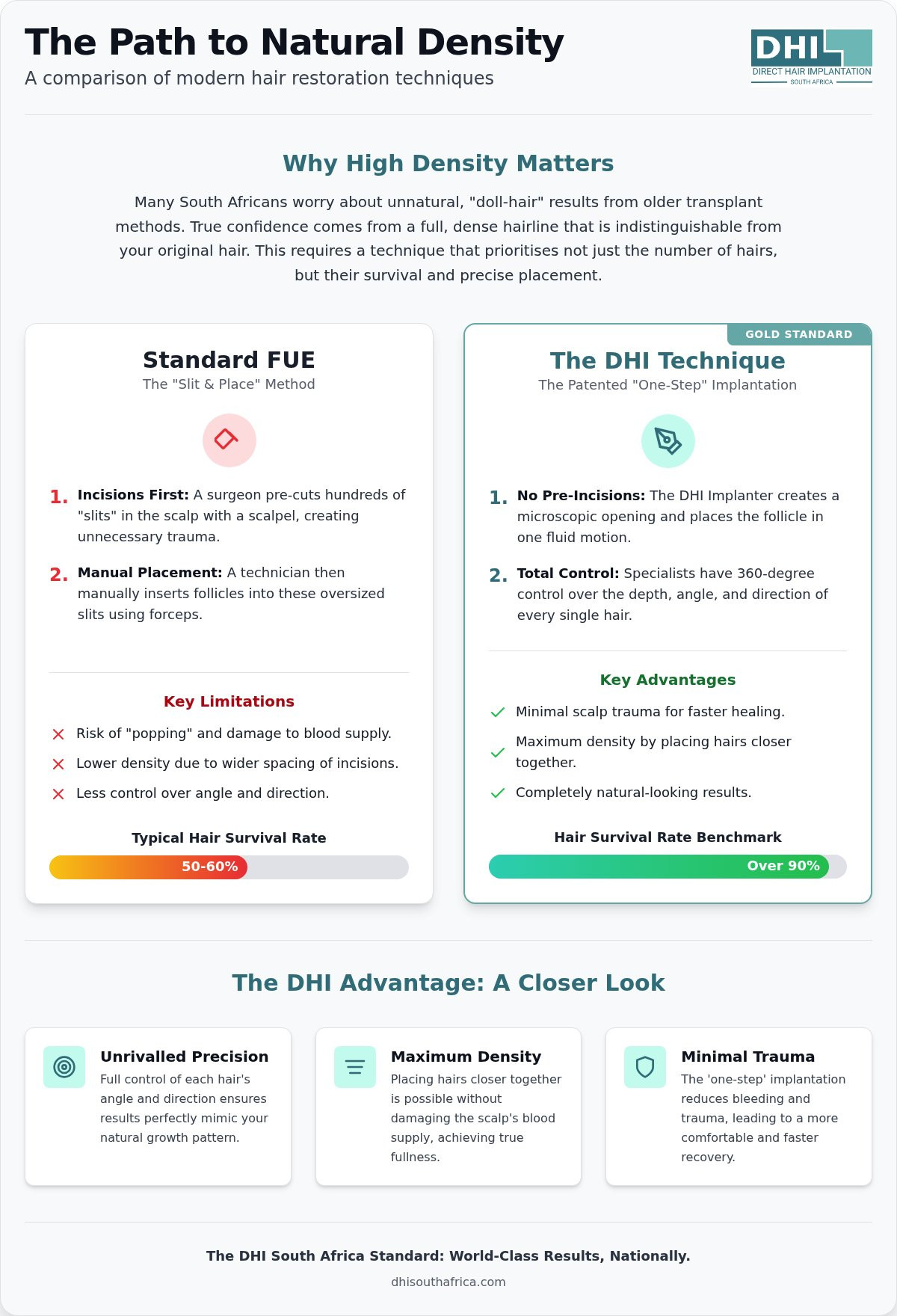
Standard FUE procedures often rely on a "slit and place" methodology. This involves a doctor creating hundreds of tiny incisions in the scalp with a scalpel or needle before another technician manually inserts the follicles. This two-step process creates a significant bottleneck for density. Because these incisions must be large enough to accommodate forceps, they can't be placed too close together without risking damage to the local blood supply.
When surgeons attempt to force high density with these older tools, they often encounter a phenomenon known as "popping." This is when the pressure of inserting one hair causes a neighbouring, newly placed hair to pop out of its socket. This unnecessary trauma to the scalp is a primary reason why traditional survival rates can hover around 50% to 60%. To achieve a truly dense result, the method must be gentler and more precise.
Understanding Natural Hair Distribution
Your hair grows in distinct, natural clusters known as follicular units. A truly successful natural hair restoration relies on the specialist's ability to mimic this organic distribution. It's not just about how many hairs we place, but the angle, direction, and depth of each one. If these factors aren't controlled, the hair will look "pluggy" or unnatural, regardless of how many thousands of hairs are used.
The challenge with high-density sessions is navigating the "safe" space between existing hairs. Standard tools are often too blunt or large for this level of artistry. By understanding that every scalp has a unique topographical map, we can plan a restoration that looks full from every angle. This level of detail is what separates a standard procedure from a world-class transformation.
The Mechanics of Precision: How the DHI Technique Enables High Density
The secret to world-class fullness lies in the physics of how each hair is handled during the procedure. While traditional methods treat extraction and implantation as separate, disconnected phases, the Direct Hair Implantation (DHI) technique is a single-step process that ensures the follicle remains outside the body for the shortest time possible. This efficiency is powered by the patented DHI Implanter, a precision instrument that gives our medical specialists total control over the restoration process. The DHI Implanter is a tool that eliminates the need for pre-made incisions by combining site creation and hair placement into one fluid motion.
By using the dhi technique for high density, we can achieve a level of proximity between hairs that was previously impossible. This isn't just about packing more hair into a space; it's about doing so without damaging the delicate blood supply that the new follicles need to survive. When hairs are placed with this level of care, the result isn't just denser; it's healthier.
Eliminating the Recipient Site Incision
In a standard FUE procedure, a doctor must first create "slots" or "slits" in the scalp. These holes are often larger than the hair itself to allow for easier insertion with forceps. This creates unnecessary trauma and forces a wider gap between each hair. With DHI, the implanter creates a microscopic opening that perfectly matches the size of the follicle being placed, allowing for much tighter grouping.
This "one-step" approach significantly reduces scalp trauma and bleeding. It allows our specialists to place hairs closer together, mimicking the natural density of your original hair. To maintain our rigorous clinical standards in South Africa, we use only single-use, titanium-coated instruments. These ensure maximum hygiene and a sharper, cleaner entry that promotes faster healing and minimal downtime for the patient.
Controlling the Angle and Direction
True density is often an aesthetic illusion created by the way hair catches the light. If hairs are placed at a generic angle, the result looks sparse and "pluggy" once it grows out. The DHI Implanter provides 360-degree control over the angle, depth, and direction of every single hair. This allows the doctor to match the natural whorls and flow of your existing hair perfectly.
Our specialists carefully organise placement to follow your natural growth pattern, ensuring the exit angle of the hair provides maximum coverage across the scalp. Precision depth is equally vital; placing a follicle at the exact right level in the dermis ensures it can access the nutrients it needs to thrive long-term. If you're curious about how this precision applies to your specific hairline, you might find our hair transplant overview helpful for understanding the full journey.
DHI vs Standard FUE: A Comparison of Density and Survival
Choosing between restoration methods often comes down to one simple question: how much hair will I actually keep? In the broader industry, the average survival rate for transplanted hairs often sits between 50% and 60%. This means for every 1,000 hairs moved, nearly half might never grow. At DHI South Africa, our standard survival rate is consistently over 90%. This stark difference is why the dhi technique for high density is considered the gold standard for patients who prioritise a full, lasting result.
Achieving a dense look isn't just about the number of hairs we extract; it's about ensuring every single hair has the best possible chance of taking root in its new home. If the follicles don't survive, the density you're dreaming of won't ever materialise. You can learn more about our specific hair transplant services to see how we manage this process from start to finish with clinical precision.
Follicle Survival: The Foundation of Density
A hair that doesn't survive the transplant is a wasted resource. Your donor area has a finite supply of hairs, and we treat every one as a precious asset. The primary reason for lower survival in standard FUE is the handling process. Follicles are often manipulated with forceps or left outside the body in suboptimal conditions for hours whilst the surgeon creates recipient sites.
We use a strict "no-touch" follicle handling protocol to protect these delicate structures. This means the hair is never touched by forceps on the bulb, which is the most sensitive part of the follicle. By using the DHI Total Care System, we keep hairs outside the body for the shortest time possible, usually in a specialised growth solution. This clinical care ensures the follicle remains healthy, leading to the high survival rates our patients expect.
Density Benchmarks: What to Expect
Standard FUE typically reaches a density limit because of the trauma caused by pre-made incisions. If a surgeon tries to pack too many hairs too close together using older methods, the scalp simply cannot heal correctly. This often results in a "see-through" look once the hair grows out, which can be frustrating for those seeking a total transformation.
Because DHI allows for much closer placement without the same level of trauma, it's the preferred choice for high-density areas. This is particularly vital for hairline lowering and crown restoration, where the eye naturally expects to see a thick, lush distribution of hair. For a deeper dive into the physics of this process, our Direct Hair Implantation pillar explains the science of natural restoration in 2026. Ultimately, the goal is to create a result that is so dense and well-integrated that even your barber won't know you've had a procedure.
Planning Your High-Density Restoration: Factors for Success
A successful restoration begins long before the first hair is placed. At DHI South Africa, we treat every procedure as a unique medical architectural project rather than a routine task. A bespoke plan is essential because your hair loss pattern, scalp elasticity, and hair texture are entirely individual to you. Using the dhi technique for high density requires a sophisticated understanding of these variables to ensure the final result looks seamless, thick, and entirely natural.
We use digital trichoscopy to begin this diagnostic process. This is a high-definition digital scalp analysis that allows us to measure your current hair density and follicular health with scientific accuracy. It's an essential tool that tells us exactly how many hairs are available in your donor area and how many are needed to achieve your specific aesthetic goals. We also carefully consider your age and the likely progression of your hair loss. It's vital to plan for the future, not just for today, to ensure you don't exhaust your donor supply prematurely. This long-term thinking is what defines a world-class medical consultation.
The Role of Donor Hair Health
High density in the recipient area is only possible if you have a robust donor site. Our specialists prioritise donor area management to ensure long-term sustainability. We use single-use, titanium-coated micro-tools to extract hairs, which prevents the visible scarring often seen with standard FUE. This careful approach keeps your donor area looking natural even with short hair styles, whilst preserving enough follicles should you require further restoration years down the line. By treating the donor area with the same respect as the hairline, we maintain the overall integrity of your hair profile.
Suitability and Aesthetic Goals
The ideal candidate for a high-density DHI procedure is someone with stable hair loss and a healthy donor supply. Whilst everyone wants "maximum density," our doctors provide honest clinical advice on what's achievable without compromising the blood flow to the scalp. If we pack hairs too tightly in an area that isn't ready for it, survival rates can drop. This is why a bespoke plan is non-negotiable. For those who need an extra boost to their results, we often recommend advanced hair loss solutions like GFC or PRP treatments to support the newly implanted hairs and improve overall scalp health. These non-surgical options can work in tandem with the transplant to create a look of total fullness.
The DHI South Africa Standard: World-Class Results Nationally
Choosing a clinic for hair restoration is a significant life decision that requires absolute trust in the medical team. At DHI South Africa, we provide more than just a procedure; we offer a global benchmark for clinical excellence. Our commitment to transparency and education ensures that you're an active participant in your restoration journey. By choosing the dhi technique for high density, you're benefiting from decades of research and a methodology that has been refined across the globe to ensure safety and efficacy.
Every specialist in our network undergoes rigorous, mandatory training at the London Academy. This isn't a simple workshop; it's a comprehensive certification that ensures every doctor masters the delicate artistry and science of hair placement. This global connection means that when you visit us in South Africa, you're receiving the same world-class care found in major medical hubs like London or Paris. We pride ourselves on being a "safe pair of hands," combining scientific precision with a patient-centric approach that values ethics above all else.
A Compassionate Approach to Restoration
We know that the journey doesn't end when you leave the clinic on the day of your procedure. We support our patients through every step, acknowledging the emotional weight that hair loss carries. Our 18-month post-procedure monitoring protocol is designed to track your progress and ensure your results are developing perfectly. We don't just aim for growth; we aim for a transformation that restores your self-assurance. Our results are engineered to look natural from every angle, providing a seamless transition from thinning to fullness that feels like yours because it is yours.
Your Path to Permanent Fullness
The beauty of this procedure is that it's an autologous solution. We use your own biological material, specifically follicles that are genetically resistant to the hormones that cause thinning. This means the results are permanent. The dhi technique for high density represents the culmination of medical innovation and compassionate care. It offers a clear, sophisticated path back to the person you recognise in the mirror without the risks or visible scarring of traditional surgery. We invite you to take the next step in your journey with the confidence that you're choosing the gold standard in hair restoration.
Reclaim Your Confidence with Precision Restoration
Achieving a dense, natural-looking hairline is no longer a matter of chance; it's a matter of clinical precision. By choosing the dhi technique for high density, you're opting for a methodology that prioritises the health of every follicle whilst ensuring a seamless aesthetic result. We've explored how the patented DHI Implanter provides total control over angle and depth, delivering a survival rate of over 90% that traditional methods simply cannot match. This protocol ensures that your donor hairs are treated as the precious resources they are, resulting in a thick, lush appearance without the need for traditional surgery.
Our certified specialists in South Africa operate under a global accreditation that guarantees world-class care right here at home. You don't have to settle for the anxieties of "pluggy" results or visible scarring. Instead, you can look forward to a permanent, scar-free transformation that is indistinguishable from your original hair. This sophisticated approach combines scientific rigour with the artistry needed to restore your self-assurance for years to come.
Your journey toward a fuller, more confident future starts with a single conversation. We're here to guide you through every phase of your restoration with the expertise and empathy you deserve.
Frequently Asked Questions
How many hairs are needed for a high-density DHI procedure?
The number of hairs required depends entirely on your current level of thinning and your aesthetic goals. For a standard high-density session, we might place between 2,500 and 4,500 hairs to achieve a lush appearance. We use digital trichoscopy during your consultation to measure your scalp precisely. This ensures we don't over-harvest your donor area whilst still providing the thickness you desire for a natural-looking transformation.
Is the DHI technique for high density more expensive than standard FUE?
While the initial investment reflects the premium nature of the procedure, it's a permanent solution. The dhi technique for high density utilises patented, single-use titanium-coated instruments and is performed exclusively by certified medical specialists. When you consider the survival rate of over 90% and the lack of visible scarring, the long-term value often exceeds that of standard FUE, which may require multiple corrective sessions to reach the same fullness.
What is the survival rate of hairs implanted using the DHI technique?
We consistently achieve a hair survival rate of over 90% due to our strict "no-touch" protocol. Standard FUE methods often see survival rates as low as 50% because follicles are handled excessively or left outside the body too long. Our DHI Total Care System ensures hairs are kept in a specialised growth solution and implanted almost immediately. This clinical precision is what makes our results so reliable and dense.
Can DHI achieve high density in a single session?
Yes, achieving high density in a single session is one of the primary advantages of this method. Because the DHI Implanter creates its own microscopic entry point, we can place hairs much closer together than traditional methods allow. This eliminates the need for staged procedures in most cases. Our specialists can pack follicles tightly whilst maintaining the blood supply, giving you a full, finished look without a second surgery.
Does a high-density transplant look natural as I age?
A professionally planned transplant will look natural for the rest of your life. We use hairs from the back of the head that are genetically resistant to thinning, meaning they won't fall out as you get older. Our doctors also design your hairline with future aging in mind. We ensure the density and placement remain appropriate for your features as they evolve, preventing an unnaturally youthful look in later decades.
How long is the recovery time after a high-density DHI procedure?
Most of our patients return to their normal daily routines within two to three days. Because we don't use scalpels or create large incisions, the recovery process is remarkably swift. You might experience some minor swelling or redness, but this typically subsides within the first week. We provide a detailed post-procedure care plan to ensure your scalp heals perfectly and your new hairs begin their growth phase without interruption.
Is the DHI technique suitable for all hair types amongst South African patients?
The DHI method is exceptionally versatile and suitable for the diverse range of hair types found in South Africa. Whether your hair is straight, wavy, or tightly curled, the 360-degree control of the implanter allows us to match your natural growth direction. This precision is especially vital for Afro-textured hair, where the subcutaneous curl requires a specialist's touch to ensure the follicle is placed safely and at the correct angle.
Will I have any visible scarring after a high-density DHI transplant?
One of the most significant benefits of this technique is the absence of visible linear scarring. We use micro-tools for both extraction and implantation, leaving only microscopic dots that are smaller than a millimetre in diameter. These heal so cleanly that they are virtually impossible to see, even if you prefer to wear your hair very short. It's a truly discreet solution for those who prioritise a natural, scar-free appearance.


Comments