%20(1).jpg)
%20(1).jpg)
Talking to Your Partner About Getting a Hair Transplant: A Thoughtful Guide

What if the conversation about a hair transplant became a chance to understand each other, rather than a request for permission? Talking to your partner about getting a hair transplant can feel difficult when you’re worried they’ll question your reasons or dismiss something that matters to you. Your feelings deserve a calm, honest conversation.
You may want your partner to understand how hair loss affects your confidence, while recognising that the decision about your body is yours. At the same time, it’s reasonable for you both to have questions about expectations, recovery, costs and practical support. Listening to those concerns doesn’t mean giving up your autonomy.
This guide will help you explain what’s motivating you, make room for your partner’s perspective and talk through the details you still need to learn. You can agree on an informed next step, whether that means taking more time or learning about DHI through a clinical assessment. There’s no need to decide everything in one conversation, or to proceed before you feel ready.
Table of Contents
Why talking to your partner about a hair transplant can feel difficult
Hair loss can affect how you feel about your appearance and confidence, but its meaning is personal. If you’re considering treatment, talking to your partner about getting a hair transplant may feel exposing. You might worry they’ll judge your reasons, reject the idea or see it as unnecessary. You can begin by explaining what has led you to consider it, inviting their questions and making clear that you’re opening a conversation, not asking for approval.
It can help to separate exploring treatment from choosing to have a procedure. You can gather information, think through your options and attend a consultation without having made a final decision. Your partner can listen or help you work through questions, while the choice about your own medical care remains yours.
A couple’s experience may offer one perspective on how partners can support each other during treatment:
What might make this conversation feel sensitive?
You may feel uneasy about being seen as overly focused on appearance, or worry that treatment could raise concerns about expense, health or changing expectations. Those feelings are understandable. They don’t mean you need to justify your choices or predict how your partner will respond.
Your partner’s questions may come from wanting to understand the procedure, timing or what you hope to achieve, rather than from opposition. Leave room for that distinction. You can acknowledge uncertainty together without treating every question as criticism or assuming it signals a problem in the relationship.
Decide what you want from your partner
Before you start, consider what would feel supportive. Would you like your partner to listen without trying to solve anything, offer reassurance, help you research or talk through practical considerations? Naming what you need gives them a clearer way to respond.
You might say, “I’m not asking you to decide for me. I’d like to tell you why I’m considering this and hear what questions come up for you.” That keeps the conversation open without handing over the decision.
If questions arise about the procedure, you can read a neutral overview of what a hair transplant involves. DHI South Africa’s hair transplant information can also help you understand DHI. These are ways to explore, not commitments to proceed.
Prepare to explain your reasons and what a hair transplant involves
A clear explanation can make the conversation feel less daunting. A hair transplant moves a person’s own hair follicles to areas being treated. Direct Hair Implantation (DHI) is one technique, using an implanter to place follicles directly. You don’t need to give your partner a technical presentation. A simple description and an honest account of why you’re exploring treatment are enough to start.
Researching a hair transplant is a way to understand your options; it is not a decision to undergo the procedure. Keeping that distinction clear can reassure both of you that the conversation is about learning, not announcing a plan that’s already set.
How to describe your personal reasons
Use first-person language to explain your experience, rather than framing treatment as something you owe to someone else. For example: “I’ve been thinking about how my hair loss affects my confidence, and I’d like to understand what my options are.” Your reasons may be about appearance, wellbeing or simple curiosity. You don’t need to claim that a transplant will make you happier, more attractive or more confident. Hair restoration isn’t a requirement for being worthy of love or a relationship.
What your partner may reasonably want to understand
Your partner may want to know what happens before any decision is made. Explain that a consultation with medical experts can provide an individual assessment, discuss whether treatment may be suitable and help clarify options. It’s also reasonable to acknowledge what you don’t yet know. Make a note of questions about the procedure, recovery and after-care to raise with a qualified clinician, rather than guessing or making promises.
If your partner asks how DHI works, keep the explanation brief: it’s a hair restoration technique that uses a DHI Implanter for direct placement, and a clinical assessment helps establish what may be appropriate for an individual. For more technical background, explore the Direct Hair Implantation information together. Reading about the method can help you identify questions, but it can’t determine personal suitability.
When talking to your partner about getting a hair transplant, aim for clarity rather than certainty. Explain what has prompted your interest, what you hope to learn and which details still need professional guidance. That gives your partner useful context without asking them to predict your results or make the decision for you.
Address concerns about expectations, safety and alternatives
Questions about treatment can be part of making an informed decision, not a sign that your partner is against you. Try sorting concerns into practical topics rather than answering everything at once. This makes it easier to identify what you can discuss together and what needs a clinician’s guidance.
Expectations: What changes are you hoping for, and what would you like to understand about possible outcomes?
Medical suitability: Is a transplant appropriate for your individual circumstances?
Procedure and recovery: What does the process involve, and what should you know about recovery and after-care?
Practicalities: What might treatment mean for timing, responsibilities or your shared plans?
Your partner’s questions can help shape the discussion, but only a qualified clinician can assess your medical suitability. Candidacy and appropriate treatment depend on an individual clinical assessment. A specialist may also discuss alternatives that could suit your needs. Transplantation isn’t the only possible path to explore.
Respond to doubts without becoming defensive
Start by acknowledging the concern, then ask what information would help. If your partner says, “I’m worried about the recovery,” you could reply, “I understand. What would you like us to find out about it?” This keeps a factual question separate from a judgement about your appearance or motivation. If either of you feels overwhelmed, pause and agree to return to the subject when you can both talk calmly.
Keep expectations realistic and decisions informed
Be open about what you hope treatment might change, but avoid promising a particular density, timeline or emotional outcome. Results and suitability vary, and a consultation is the appropriate place to discuss what may be realistic for you. Your partner can help you note questions, but personal stories and promotional material can’t replace individual clinical advice.
Before an appointment, write down questions about the assessment, possible approaches, the procedure, recovery and after-care. That gives you a practical starting point without requiring either of you to reach a decision straight away. You can review DHI South Africa’s hair transplant information together, then use any questions it raises to guide a discussion with medical experts.
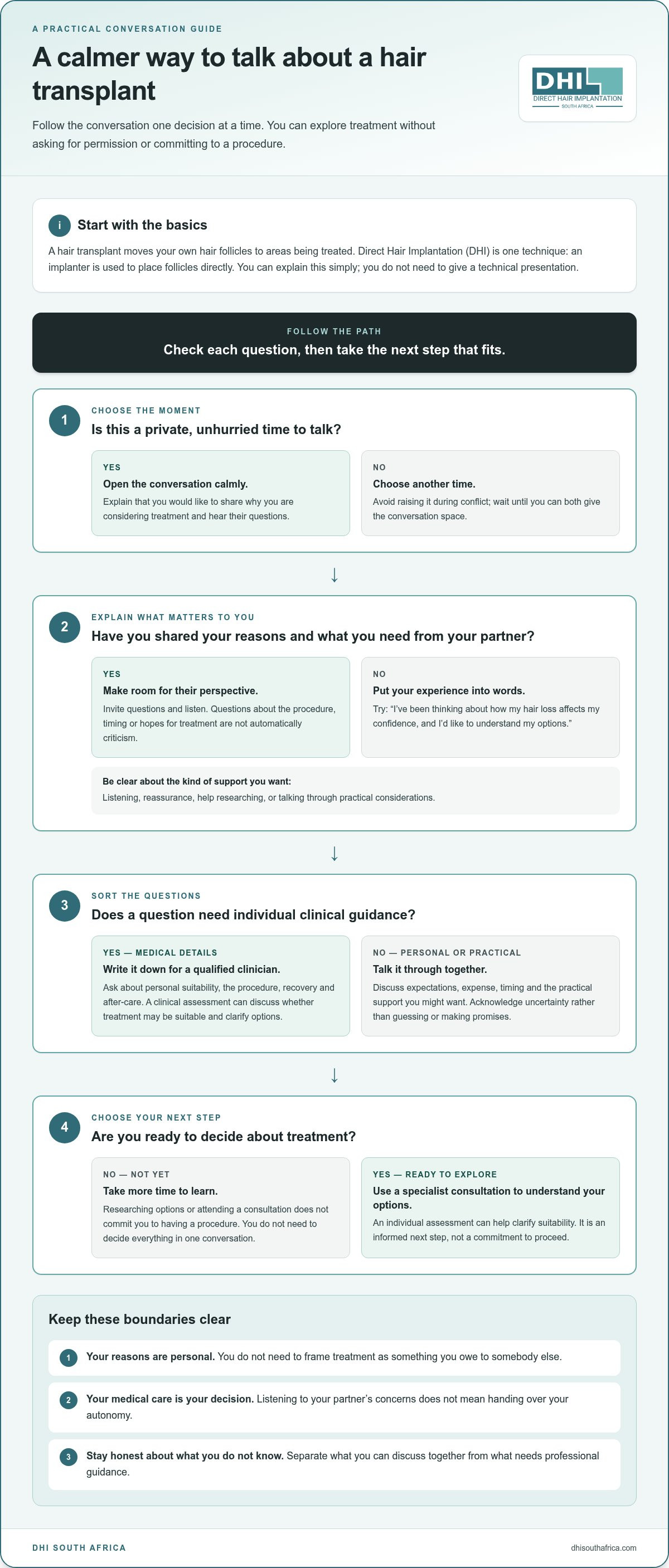
Use a calm, practical conversation plan
A little preparation can help you speak openly without turning the discussion into a pitch or a test of your partner’s support. Choose a private, unhurried moment when neither of you is distracted or already dealing with conflict. You don’t need to have every answer ready. The aim is to share what you’re considering and make room for an honest response.
A simple sequence can keep the conversation grounded:
Choose the moment: Find a setting where you can talk without an audience or pressure to finish quickly.
Explain your reasons: Describe what has prompted your interest in your own words.
Invite questions: Ask what your partner would like to understand, then listen without rushing to defend your decision.
Share what you know: Be clear about what you’ve learnt and what still needs a clinician’s guidance.
Agree a next step: Decide whether to leave it there for now, gather information or revisit the discussion later.
A simple way to start the conversation
You could begin with: “I’ve been thinking about a hair transplant and would like to talk through what it means to me.” Adapt the wording so it sounds like you. Then say what kind of support would help: perhaps you’d like your partner to listen first or to review information with you. Stating this plainly can prevent them from having to guess what you need.
Talking to your partner about getting a hair transplant doesn’t require a polished speech. A natural opener, followed by a pause, can be more reassuring than trying to persuade them. You might add, “I’m still learning about it, and I’d like to hear what questions you have. You don’t need to respond straight away.”
Listen, answer what you can and agree what comes next
Give your partner space to respond. If they raise a concern, reflect it back before you answer: “It sounds like you’re wondering how recovery could affect our plans. Have I understood?” This shows you’ve heard them without implying that you agree with every conclusion. Answer what you know, and note medical questions you can’t answer rather than guessing or debating.
There’s no need to settle everything in one sitting. You could each take time to think, write down questions and then have another conversation. If you both want more clinical context, a specialist consultation can help you discuss personal suitability and treatment questions without obliging you to proceed.
Choose an informed next step together, without pressure
A thoughtful conversation doesn’t commit you to having a hair transplant. It can simply help you decide what you want to find out next. You might choose to pause, read more or arrange a specialist consultation to discuss your questions. The pace is yours to set, and you can change your mind as you learn more.
When a specialist consultation can help
Review DHI South Africa’s hair transplant information before deciding whether a consultation feels like the right next step. You could each note what you want clarified, then bring those questions to a discussion with a specialist. No outcome or treatment choice needs to be assumed in advance.
Agree on support that feels right for both of you
Support can take different forms. Your partner might attend a consultation with you, read information together or simply listen as you think things through. What matters is agreeing on what would genuinely help, rather than expecting your partner to take responsibility for the decision.
There’s a useful distinction between practical support and permission. Your partner can share concerns and help you consider the implications, but the choice about your medical care remains personal. Equally, they’re allowed time to process what you’ve shared. You don’t have to reach the same level of certainty at the same moment.
As talking to your partner about getting a hair transplant moves towards a possible next step, check in with each other: “Would it help to look at the information together, or would you rather take some time first?” You might agree to revisit the subject after you’ve both had space to think. It’s also completely reasonable for the next step to be no step yet.
Take the next step at your own pace
Talking to your partner about getting a hair transplant can be an opportunity to share what matters to you, not a request for permission or an immediate decision. Explain your personal reasons, invite questions and be honest about what you still need to learn. Your partner may offer practical or emotional support, whilst the decision about your medical care remains yours.
Keep expectations grounded. Questions about suitability, possible outcomes, recovery and alternatives are worth discussing, but they don’t need to be resolved between the two of you. A professional consultation with medical experts can provide an individual assessment and help you understand treatment options. Exploring information or attending a consultation doesn’t commit you to a procedure. It’s a way to make any later decision better informed.
There’s no need to rush. Take the conversation one step at a time, and give yourself room to decide what feels right for you.
Frequently Asked Questions
How do I tell my partner I want a hair transplant?
Choose a calm, private moment and explain your reasons in your own words. You might say, “I’ve been thinking about a hair transplant because hair loss has been affecting how I feel, and I’d like to explore my options.” Talking to your partner about getting a hair transplant doesn’t mean you’ve decided to proceed. Tell them whether you’d value listening, reassurance or looking at information together, then leave room for questions and note medical concerns for a specialist.
Should I get my partner's approval before having a hair transplant?
No, your partner doesn’t need to make the decision for you. A hair transplant is a personal medical choice, and your autonomy matters. Still, an open discussion can help you explain your motivations and understand concerns about practical matters that may affect you both. You can consider your partner’s perspective without treating agreement as a condition of your choice. Their support also doesn’t replace a clinical assessment or advice from medical experts.
What if my partner is against me getting a hair transplant?
Ask what is behind their objection before you respond. They may be concerned about your health, expectations, recovery or whether you’re deciding too quickly. Listen, then share reliable information and write down medical questions to discuss with a specialist. You don’t have to settle the disagreement in one conversation. Your partner’s reaction alone can’t establish whether treatment is medically suitable; that requires an individual assessment by a qualified clinician.
Can a hair transplant affect a relationship?
It can lead to conversations about confidence, appearance, expectations and practical support, but every relationship is different. A transplant doesn’t guarantee greater intimacy, nor does it necessarily create tension. Talk about what considering treatment means to you and what your partner is wondering about. You can also discuss how you’d communicate as you learn more. Making space for different feelings may help you understand each other without assuming how either of you will feel later.
How much should I tell my partner about a hair transplant?
Share enough to explain why you’re considering it and what you currently understand about the procedure. Be candid about what you don’t yet know, such as personal suitability, recovery or possible outcomes, and explain that you plan to ask a clinician. You don’t need to cover every technical detail at once. Invite your partner to ask questions, then decide which information would be useful to review together or raise at a consultation.
What should I do if my partner worries about the risks or results?
Take the concern seriously, but don’t try to reassure your partner with guarantees. Note questions about medical suitability, procedure details, recovery and expected outcomes, then raise them with a qualified specialist. Recommendations and possible results vary between individuals, so general information may not answer what applies to you. A consultation with medical experts can help clarify your questions and options; attending one doesn’t oblige you to proceed with treatment.
Should we attend a hair transplant consultation together?
You can attend together if you both want to; your partner may then hear clinical information and raise practical questions. You can also go alone and share what you choose afterwards. A consultation is an opportunity to discuss your individual circumstances, suitability and treatment options with medical experts. It supports your understanding, not a commitment to have a procedure, and your partner isn’t expected to decide for you. Choose the arrangement that feels comfortable.


Comments